
Quick answer
Start with the issuer’s current exam code, version, effective date, objective list, and change notice-not the course title. Build an objective-level evidence grid, preserve the issuer’s verbs, mark each objective as direct, partial, adjacent, absent, or unverified, and record the exact lesson, lab, or assessment that supports the status.
Delay the purchase when the exam blueprint and course version do not match, when an outline transition overlaps your planned exam date, or when the syllabus is too vague to support objective-level mapping. This is an E1 source-led method; it does not prove teaching quality or exam readiness.
Evidence and scope
- Evidence profile
- E1 – official-source objective-mapping workflow
- Information checked
- Primary market
- United States; English-language certification preparation
- Direct evaluation
- Not performed
- Issuer examples
- Microsoft, AWS, Cisco, and ISC2
- Main limitation
- No paid course, lesson, lab, assessment, instructor support channel, update workflow, accessibility flow, device flow, or exam-readiness outcome was directly tested.
This guide explains how to compare a course syllabus with the current certification authority for the exam you intend to take. It uses current issuer pages and outlines to demonstrate version, effective-date, domain, task, and change-log controls. It does not certify that a named course is complete, current, effective, accessible, or sufficient for any learner.
Key facts before you map a course
On a small screen, swipe or scroll the table horizontally to compare all columns.
| Issuer example | Current authority signal | Mapping consequence |
|---|---|---|
| Microsoft AZ-900 | The AZ-900 study guide identifies skills measured as of July 20, 2026 and includes a change log. | Record the measured-skills date and compare the course update date with the issuer change date. |
| AWS SAA-C03 | The SAA-C03 exam guide uses an exam code, four weighted domains, task statements, and separate in-scope and out-of-scope service lists. | Map tasks and service scope, not just broad cloud topic names. |
| Cisco CCNA | The current CCNA exam page identifies 200-301 CCNA v1.1, while Cisco’s training page separately lists course objectives and labs. | Do not treat an official course outline as a substitute for the exam-topic authority. |
| ISC2 CC | The current CC exam-outline page identifies an outline effective September 1, 2026; the earlier outline is dated October 1, 2025. | Choose the outline that applies to the scheduled exam date and keep the other version visibly separate. |
Issuers expose different kinds of version evidence. A reliable mapping records the authority actually available for that exam rather than forcing every certification into one identical template.
Why a matching course title is not enough
A course can use the correct certification name while still leaving the version, effective date, objective depth, practical work, or update policy unclear. “Updated,” “complete,” and “exam aligned” are provider statements until the syllabus supplies evidence that can be tied to the current issuer authority.
The issuer documents also differ in granularity. Microsoft’s AZ-900 guide publishes dated skill groups, objective bullets, and a change log. AWS publishes weighted domains and task statements, plus technology and concept references; AWS also states that several lists are non-exhaustive and subject to change. Cisco’s current CCNA page identifies exam code and version, while its official training course publishes a distinct course objective and lab outline. ISC2 publishes an effective-date notice and current five-domain outline; retain any prior outline separately when checking transition history.
These differences create three common purchasing risks. First, a course may map to the wrong exam code or retired objective set. Second, a topic-level syllabus may hide gaps in the action the objective requires. Third, a course may contain substantial useful material that is adjacent to the exam but should not be counted as direct objective coverage.
The decision rule
Proceed to deeper purchase review
The exact exam identity matches, the applicable outline is clear, the syllabus exposes enough lesson-level evidence to map objectives, material gaps are visible, and the provider explains how updates are handled.
Compare or request clarification
The course appears relevant, but some objectives are only partially supported, practical requirements are unclear, or the provider has not shown how the course changed after the issuer’s latest update.
Delay the purchase
The exam code, version, effective date, syllabus, or update history is missing; the mapped outline will not apply on your planned exam date; or the provider relies on broad completeness claims without auditable coverage evidence.
Passing this workflow does not establish course quality or guarantee an exam result. It only shows that the available evidence is sufficiently current and specific for the next stage of evaluation.
Eight-step course-to-objective mapping workflow
1. Freeze the exam identity
Record the certification, exam code, version, language, issuer URL, objective or study-guide title, effective date, and the date you checked it. Do not begin with a provider’s course landing page. The current Cisco page, for example, identifies 200-301 CCNA v1.1; AWS uses SAA-C03; Microsoft publishes a dated AZ-900 skills page.
Treat similar names as separate until the code and version match. If the issuer does not expose a version number, preserve whatever authority it does expose, such as a “skills measured as of” date, an effective date, or a current exam-guide URL.
2. Check for current and transition outlines
Search the issuer’s certification page, exam outline, study guide, and change notice for a transition date. ISC2’s current page states that the CC exam is based on an outline effective September 1, 2026 and publishes five domain weights. The earlier October 1, 2025 outline remains useful only as transition history; its domain names and weights differ.
Map against the outline that will govern your scheduled exam. If you have not selected an exam date, keep both versions separate and ask whether the course supports the current outline or a defined transition path. Do not merge two objective sets into one artificial syllabus score.
3. Preserve the objective hierarchy and verbs
Copy the issuer’s domain, task, objective, and sub-objective structure into a working sheet. Preserve verbs such as describe, design, implement, determine, configure, and troubleshoot. A lesson that defines a technology is not automatically evidence that the learner practices designing, configuring, or troubleshooting it.
Microsoft notes that bullets illustrate how a skill is assessed and that related topics may appear. AWS says its guide is not a comprehensive content list and that technology and service lists are non-exhaustive. Therefore, use the objective hierarchy as the minimum mapping authority, not as proof that every possible exam topic has been enumerated.
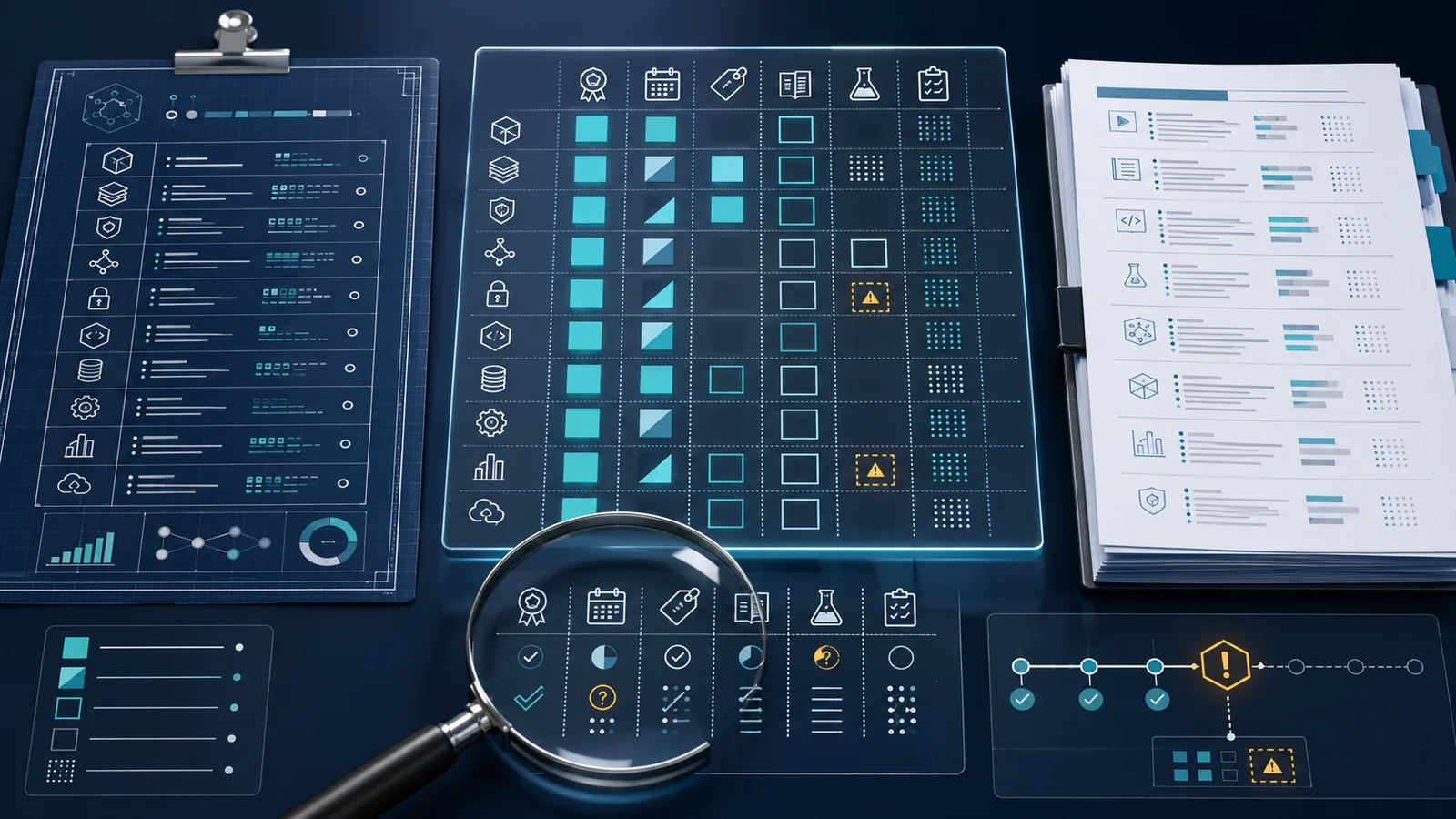
4. Build an evidence grid before assigning coverage
On a small screen, swipe or scroll the table horizontally to compare all columns.
| Status | Evidence standard | Buyer action |
|---|---|---|
| Direct | An explicit lesson, lab, exercise, or assessment addresses the same objective and required action. | Record the exact module and evidence type. |
| Partial | The course addresses only part of a multi-part objective or uses a shallower action. | Name the uncovered sub-objective or action. |
| Adjacent | The material is relevant background but does not demonstrate the objective itself. | Keep it useful, but exclude it from direct coverage. |
| Absent | The available syllabus is detailed enough to show that the objective is not covered. | Plan a supplement or reject the course for this use. |
| Unverified | The syllabus, sample, or provider response is too vague to decide. | Request evidence; do not assume coverage. |
Each row should contain the issuer objective ID or exact text, domain weight if published, course module, lesson or lab evidence, evidence type, status, reviewer note, and checked date. Preserve the provider’s wording separately from your status so another reviewer can reproduce the decision. Avoid a single “covers everything” checkbox.
Before mapping the entire outline, sample objectives from the beginning, middle, and end of every domain. Include at least one knowledge-oriented verb and one applied verb where the issuer uses both. A sample that produces mostly unverified rows is a signal that the public syllabus is too vague for a defensible full audit; it is not a reason to award optimistic coverage.
5. Audit objective coverage, not keyword overlap
Review every objective row. Keyword matching is a discovery aid, not a coverage decision. A course may mention “identity,” “networking,” or “cost optimization” without addressing the required task, decision context, or practical action.
Use domain weights to prioritize review effort and to make large gaps visible, but do not discard lower-weight objectives. AWS’s SAA-C03 domains are weighted 30%, 26%, 24%, and 20%; ISC2 publishes weights for each CC domain. These weights describe exam emphasis, not permission to omit the rest of the published scope.
Do not turn the grid into a percentage unless every denominator rule is disclosed and each objective has been reviewed at the same level of detail. A count of course modules is not an objective-coverage denominator, and a long lesson does not automatically deserve more credit than a short lesson. For this workflow, the safe output is a list of evidenced statuses and material gaps rather than a readiness score.
6. Separate explanation, practice, and assessment evidence
Record whether the course provides explanation, guided demonstration, independent practice, feedback, and assessment for objectives that require application. Cisco’s official CCNA training page separates course objectives from a lab outline, which illustrates why a topic list and a practice inventory should not be treated as the same evidence.
A syllabus can support a claim that a topic is taught, but it cannot prove the lab works, the assessment is valid, the feedback is useful, or the learner can perform the task. Those are direct-evaluation questions and remain unknown until separately tested.
7. Verify the update trail
Compare the course’s last update, version label, syllabus revision, and provider change note with the issuer’s current authority. Microsoft publishes a dated skills section and change log for AZ-900. When an issuer identifies minor, major, added, removed, or reworded objectives, the provider should show which lessons or assessments changed.
A recent marketing-page timestamp is weaker evidence than a versioned syllabus or objective map. If the provider cannot explain its update trail, mark changed objectives unverified even when the course title says “current.”
Review the issuer change log row by row. An objective can be added, removed, moved, merged, split, or reworded without the high-level domain title changing. “No change” at the domain level therefore does not eliminate the need to inspect lower-level objectives when the issuer publishes more detailed revision evidence.
8. Record gaps and apply a stop rule
Summarize direct, partial, adjacent, absent, and unverified rows without converting them into an unsupported readiness score. Identify material gaps, the supplement needed, the evidence still requested, and the date by which the mapping must be refreshed.
Stop the purchase review when the course maps to the wrong exam identity, an inapplicable outline, an undisclosed transition, or a syllabus too vague for objective-level evidence. Continue only when the remaining gaps are explicit and acceptable for your plan.
What to do when one course is incomplete
An incomplete mapping does not automatically make a course unusable. It may be a focused explanation source, a lab supplement, a practice-question tool, or a transition resource. Assign it one role and fill only the documented gap.
- Use issuer documentation for newly added or changed objectives when a commercial course has not yet shown an update.
- Add targeted practice when the course explains an applied objective but provides no lab or scenario evidence.
- Add an assessment source when lessons exist but there is no evidence of retrieval or objective-level diagnosis.
- Choose a different course when the core exam identity is wrong or the material gaps are too broad to manage.
- Delay the exam date when a blueprint transition makes the applicable scope uncertain and the provider has not published a migration plan.
Purchase terms, access length, instructor support, accessibility, refunds, and total cost are separate buyer questions. Objective alignment should be established before those factors are weighed, not used as a substitute for them.
Keep the mapping portable. Save the issuer snapshot, course syllabus, provider response, and your grid with dates and version labels. That record lets you refresh only the changed objectives when an issuer updates the blueprint instead of repeating the entire decision from memory.
Unknowns and limitations
- Issuer pages and outlines can change after the checked date.
- Exam objectives may be explicitly non-exhaustive, so a complete row mapping is not a guarantee of complete exam coverage.
- Course syllabi can omit detail even when the underlying content is broader; omitted evidence remains unverified, not automatically absent.
- No course account, sample lesson, lab, practice test, instructor interaction, or update workflow was directly evaluated for this article.
- No pass probability, score improvement, completion time, job outcome, or return on investment can be inferred from objective alignment.
- Localized exams and translated course materials may update on a different schedule; verify the language you will actually use.
- Provider statements about completeness or alignment are recorded as provider evidence, not independent proof.
Your next action
For a Security+ path, compare the resulting objective map with the Security+ training-format comparison; that page addresses course formats, not objective coverage.
- Save the issuer’s current objective authority and record the exam code, version, effective date, language, URL, and checked date.
- Obtain the candidate course’s dated syllabus, lesson list, lab list, assessment description, and update policy.
- Map ten representative objectives from different domains before committing to a full audit.
- Expand to every objective only when the sample shows that the syllabus is specific enough to support evidence-based statuses.
- Proceed, compare, or delay using the stop rules above; do not translate the grid into a pass guarantee.
Methodology
Course Evidence reviewed official issuer materials available on September 11, 2026. The examples were selected to show different control patterns: a dated skills page and change log from Microsoft; a code-based, weighted task guide with service-scope references from AWS; a versioned exam page and separate official course/lab outline from Cisco; and dated current and transition outlines from ISC2.
The coverage statuses and stop rules are an editorial decision framework derived from those source structures. They are not issuer scoring methods. This evidence profile follows the Course Evidence method. No provider course was tested, no learner data was collected, and no objective-coverage score or winner was calculated. Any future visible claim about a named course requires its own current syllabus evidence and, for behavioral claims, an approved direct-evaluation branch.
Sources
- Microsoft Learn – AZ-900 study guide and change log
- Microsoft Learn – Azure Fundamentals certification page
- Microsoft Learn – SC-100 study guide change-log example
- Microsoft Learn – GH-500 study guide change notice
- AWS – SAA-C03 exam guide
- AWS – SAA-C03 technologies and concepts
- AWS – SAA-C03 in-scope services
- AWS – SAA-C03 out-of-scope services
- AWS – SAA-C03 Domain 1 task detail
- Cisco – 200-301 CCNA v1.1 exam page
- Cisco – official CCNA course objectives and lab outline
- Cisco – current certification exams list
- ISC2 – CC exam-outline page and transition notice
- ISC2 – CC outline effective October 1, 2025
- ISC2 – CC outline effective September 1, 2026
- ISC2 – Certified in Cybersecurity certification page