
Quick answer
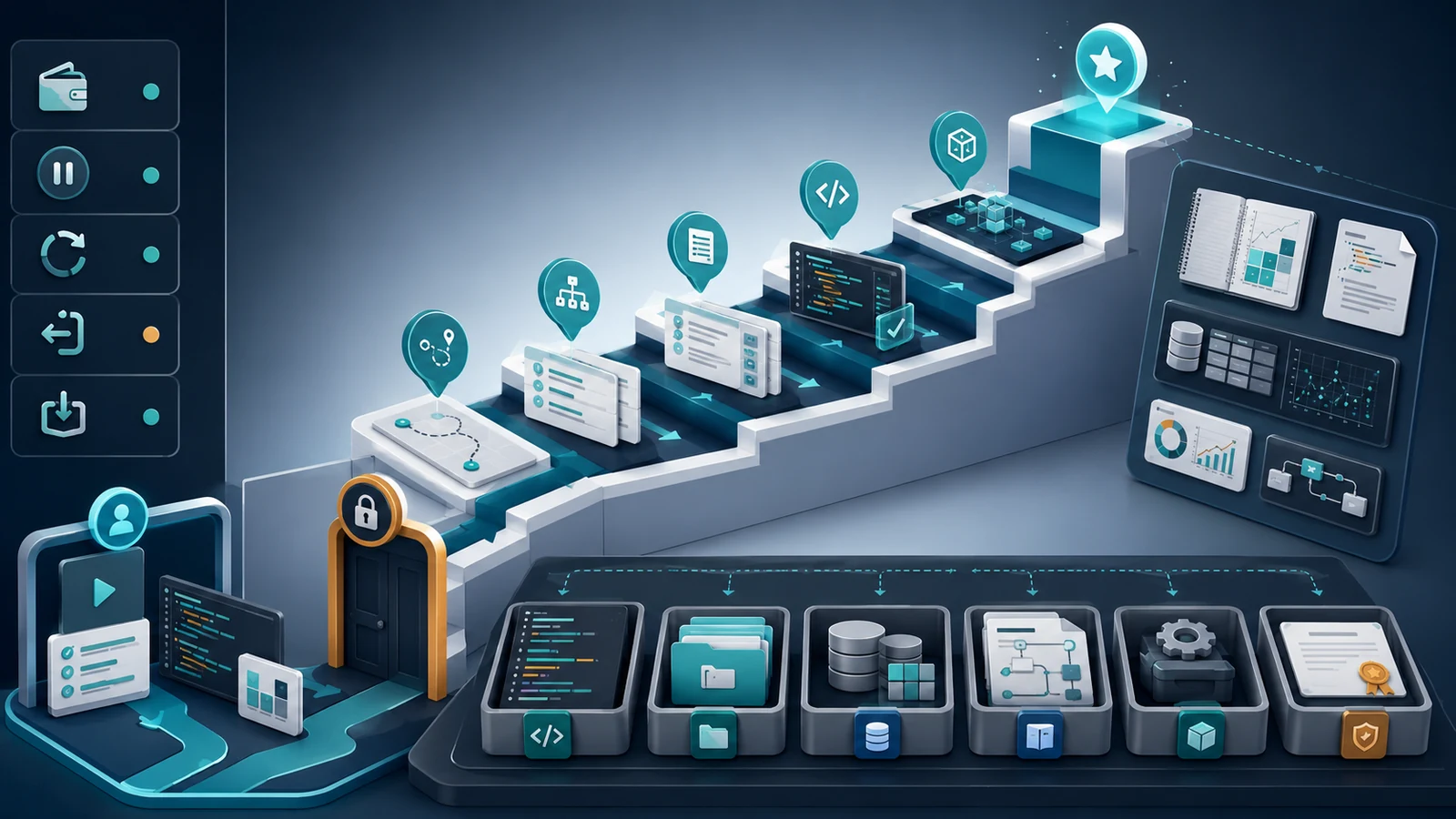
Evidence profile: E1 source-led research, so this is a documentation-based platform analysis rather than a hands-on review. Dataquest is a plausible fit when you prefer a text-and-code workflow in which paths contain courses, courses contain lessons and coding steps, and many courses end with a guided project. The model is most useful when you can name one capability and one artifact-such as a notebook, Python script, SQL analysis, dashboard, or small pipeline-and use the free content to inspect the editor and teaching sequence before paying.
It is a weaker fit when you need a validated small-screen workflow, an accredited credential, or proof that guided work will transfer to an independent portfolio project. Premium unlocks the full catalog, practice problems, and guided projects, but the official support pages separate path content, code files, datasets, certificates, progress, AI assistance, and subscription rights. Verify the exact path, project count, export route, billing period, renewal amount, pause behavior, and refund window before committing. Review the current plan comparison.
Evidence and scope
- Evidence profile
- E1 – current official public-source review
- Information checked
- Target market
- United States individual learners; US English
- Scope
- Dataquest’s documented paths, courses, lessons, coding steps, guided projects, progress, certificates, exports, support, plan entitlements, renewal, pause, refund, and post-expiration access
- Direct evaluation
- Not performed
- Main limitation
- No platform session, answer checker, Jupyter project, code download, dataset export, support interaction, mobile workflow, checkout, cancellation, pause, or refund request was observed.
Dataquest’s current Terms of Use identify Dataquest Labs, Inc. as the service operator and limit use of the service and protected instructional material. This article explains the documented learning and commercial model; it is not a hands-on review, teaching-quality rating, portfolio assessment, or career-outcome evaluation. See How we test for the evidence labels and testing boundaries used here.
Key facts before subscribing
- The documented hierarchy runs from paths to courses, lessons, submitted steps, and guided projects; these are different planning units.
- The current Career Paths catalog uses role-oriented labels, but each path page has its own curriculum, projects, prerequisites, and provider estimates.
- Completing a course requires its lessons and guided projects; completing a path requires all content in that path.
- The Data Analyst in Python and Data Engineer path pages illustrate materially different sequences, so a role label alone is not enough to choose a path.
- The current plan page distinguishes Free introductory content and limited practice or project access from Premium access to the full catalog, practice sets, guided projects, assessments, and certificates; exact entitlements can change and should be checked at decision time.
- Guided projects reduce explicit instruction and are intended to bridge lessons and more independent work, but this article did not test that transfer.
- Learner-written code can be downloaded after a subscription ends. Instructional text is not downloadable, and dataset access has separate Premium and project-export rules.
- Project files, lesson code, datasets, and portfolio exports use separate save or download routes; no recovery or local-reproduction workflow was tested for this article.
- Subscriptions recur until canceled or paused. Pause and cancellation take effect after the current paid period, while refund eligibility is a separate dated policy.
Free and Premium access boundaries are summarized in Dataquest’s current Premium support guide, while the current role-oriented inventory appears in the Career Paths catalog.
Who should use this analysis
Use this article if you are considering Dataquest as a structured, browser-based route from instruction to a project artifact. The relevant decision is not simply whether the catalog contains Python, SQL, R, data engineering, analytics, or AI. It is whether the exact path places the right lessons and projects between your current skill level and the artifact you want to produce.
The analysis is most useful when you can write a narrow goal such as “build and explain one pandas analysis notebook,” “write SQL queries against several related tables,” “automate one small data-cleaning workflow,” or “complete one guided project and then reproduce the core work locally.” The platform may provide a sequence and an in-browser environment, but you still need a standard for independence, export, verification, and reuse.
This page does not compare Dataquest with DataCamp, rank course quality, validate job-market claims, or decide whether a certificate will be recognized. It also does not replace a direct common-task comparison, a detailed DataCamp pricing analysis, a course-to-portfolio workflow test, or a cross-platform portability benchmark.
The documented platform model at a glance
On a small screen, swipe or scroll the table horizontally to compare all columns.
| Surface | Documented role | Useful evidence | What remains unproven |
|---|---|---|---|
| Career Path | Longer grouping of courses aligned with a role | Whether the route names the skills and projects you expect to study | Personal fit, current labor-market relevance, completeness, and outcome value |
| Skill Path | Narrower course sequence focused on a concrete skill | Whether a smaller route closes one defined gap without a full career sequence | Whether prerequisites and pacing match your current knowledge |
| Course and lesson | Lessons and coding steps organized around a bounded topic | Submitted answers, notes, and code showing that you completed the platform sequence | Independent problem framing, external reproducibility, and teaching effectiveness |
| Guided Project | Less-explicit project work intended to apply prior lessons | A notebook or code-and-data package that can be reviewed and extended | Originality, independence, portfolio readiness, and transfer to a new dataset |
| Certificate | Completion record for a paid course or path | Evidence that Dataquest marked the required content complete | Accreditation, employer recognition, skill depth, and job readiness |
| Premium subscription | Paid access to the full catalog, practice problems, and guided projects | Access to the exact path and export workflow you have selected | Checkout total, tax, promotion, renewal amount, support quality, and personal value |
Takeaway: choose the smallest Dataquest surface that produces your next evidence artifact. A path title, lesson streak, project completion, code export, and certificate are related records, but they do not establish the same capability.
Paths, courses, and completion rules
Read the hierarchy before the catalog
Dataquest organizes content as paths, parts, courses, lessons, steps, and guided projects. A path is therefore not one course, and a course is not only a list of lessons. The current completion guide says a path requires all of its content and a course requires its lessons and guided projects. Before enrolling, inspect the full outline and mark which items produce new capability rather than duplicate material you already know.
Inspect the exact path, not only the role label
The current Career Paths catalog groups routes under role-oriented labels, but the buyer decision depends on the exact curriculum and project handoffs. The Data Analyst in Python path emphasizes Python, SQL, analysis, visualization, statistics, and projects, while the Data Engineer path extends into databases, pipelines, distributed processing, containers, and cloud-oriented work. Treat provider time estimates and path labels as planning aids, not completion or employment guarantees.
Audit prerequisites and duplicated coverage before paying
Two role-labelled paths can share foundational topics while diverging later. Record the exact courses, projects, required languages, local-tool expectations, and output artifacts in the path you intend to use. Do not assume that a familiar title eliminates prerequisites or that a listed project proves independent ability. A conservative purchase decision identifies which parts close a real gap and which parts repeat work you can already demonstrate.
Use free entry to audit the teaching loop
The current plan documentation distinguishes Free from Premium and shows limited introductory practice or project access on Free. Use one currently available free item to inspect one complete loop: read the explanation, write code, run it, submit it to the answer checker, review feedback, and decide whether the amount of guidance fits your background. Dataquest’s answer-checker troubleshooting guide documents the Submit Answer dependency. Free access can reveal the interface and lesson rhythm; it cannot establish the value of the full path or its later projects.
Guided projects, exports, and certificates
Guided projects are a bridge, not an independence certificate
Dataquest describes Guided Projects as a bridge from instructional lessons to end-to-end work, with less explicit instruction than ordinary lessons and real-world datasets. The Guided Projects overview supports this intended role. A useful buyer test is whether the project requires you to choose, explain, and debug meaningful steps rather than merely reproduce a supplied sequence. That question was not directly tested here.
Learner-written code can persist after the subscription
Dataquest documents a profile-based code download for ordinary lesson work and a notebook download route for Jupyter-based projects. It also says the downloaded lesson-code archive excludes the lesson instructions and datasets. The code-download guide states that learner-written code remains downloadable after cancellation. Before relying on that promise, identify the exact file format and test whether the artifact runs outside the platform with your own environment and dependencies.
Datasets use a separate access and export rule
Downloadable datasets are documented as a Premium feature. Lesson datasets are downloaded separately, while the project download can package the notebook and project data together in a compressed archive. The dataset-download guide describes those routes. Dataset availability does not by itself establish reuse rights, provenance quality, or reproducibility; keep the source, license, transformations, and environment notes with any artifact you plan to retain.
Back up project files and define the portfolio handoff
Project work has a separate recovery and handoff boundary. Dataquest’s Guided Project restore guide documents backup and recovery steps and warns about file-overwrite risk when multiple projects are open. Its portfolio guidance permits downloading, extending, and publishing completed project work, but that does not establish originality or hiring value. Keep provider scaffolding, your changes, dataset provenance, environment notes, and attribution visibly separate.
Certificates record completion, not accreditation
Dataquest issues certificates for completed paid courses and paths and supports downloading or sharing them. Its current certificate guide explicitly says the courses are not accredited. The certificate guidance supports only a completion-record claim. It does not establish employer recognition, independent assessment, portfolio quality, hiring, salary, or job readiness.
AI and support surfaces are documented, but quality is untested
Dataquest documents Chandra AI, code explanations, exercise assistance, the Help Center, and community support as learner-assistance surfaces. The Chandra guidance and Premium support guide establish availability, not accuracy, privacy behavior, response time, or learning effectiveness. This article did not submit a question or evaluate an answer.
Pricing, renewal, pause, and refunds
On a small screen, swipe or scroll the table horizontally to compare all columns.
| Area | Documented boundary | Buyer action |
|---|---|---|
| Free | The current plan page offers Free introductory content, with practice and guided-project access shown as limited; the live catalog can mark individual courses or projects as free | Test one lesson loop, editor behavior, browser compatibility, and the outline of the exact path |
| Premium standard full price | Public plan and support pages describe monthly or annual Premium billing, but the displayed amount, currency, promotion, tax, and available plan options require a current location-specific checkout check | Capture current currency, promotion, tax, billing basis, and renewal amount before paying |
| Renewal | Monthly and annual subscriptions auto-renew until canceled or paused | Record the renewal date and confirm the next charge in the subscription page |
| Pause | The support documentation describes a pause route and a later return to paid access; the exact pause window, effective date, and restart behavior must be verified in the current account | Treat the restart date as a future charge and set a reminder before access resumes |
| Refund | The public plans page currently displays a 30-day full-refund statement, while the dedicated refund article and account terms may apply additional conditions | Treat the conflict as unresolved, use the stricter window for planning, and confirm the current account terms before paying |
| After expiration | The expiration documentation describes a return to Free and identifies some retained records or downloads, but the exact post-expiration entitlement must be checked against the current account terms | Export essential code and data before the term ends and verify what remains accessible afterward |
The public cost guide provides the current commercial boundaries above, while the auto-renewal guide explains recurring billing. Treat both as dated public documentation, not a checkout quote.
The current pause guide, dedicated refund article, and expiration guide should be rechecked immediately before a purchase, renewal, cancellation, or refund decision. The public plans page currently displays a 30-day full-refund statement, while the dedicated refund article remains the controlling support reference and may contain additional conditions. Because official summaries and account terms can change, confirm the current checkout and support policy, preserve the charge record, and do not treat a marketing summary as a universal entitlement. This summary is not legal advice and does not predict an individual refund outcome.
Lower-commitment routes before Premium
The goal is not to avoid paid learning. It is to delay the larger commitment until the exact learning and project job is clear. Before subscribing, you can:
- start with a currently marked-free course, lesson, or project in the live catalog;
- choose a narrow Skill Path instead of a long Career Path when only one capability is missing;
- use official language, library, database, or tool documentation beside a small local notebook or script;
- reproduce one free lesson’s core idea with a different dataset to test independence;
- write the export checklist before starting: code, data, dependencies, environment, source, license, and explanation;
- pause the buying decision when network, mobile, accessibility, support, or refund requirements remain material and unverified.
A valid decision may be “use Dataquest for structured instruction but complete the final artifact locally,” “buy one month for a bounded Skill Path,” “choose annual access only after the first project works,” or “do not subscribe yet.” This article does not decide among other platforms.
Unknowns and limitations
- No account, path, lesson, code step, answer checker, practice problem, guided project, notebook, dataset export, certificate, or support route was directly used.
- No finding is made about teaching quality, explanation clarity, feedback accuracy, challenge difficulty, project independence, or curriculum coherence.
- Catalog contents, path outlines, project counts, prerequisites, completion estimates, and named technologies can change after the checked date.
- Public commercial information is not a final United States invoice. Promotion, currency, tax, payment method, plan availability, and renewal amount can differ.
- No browser, tablet, phone, keyboard, screen-reader, caption, contrast, bandwidth, latency, or accessibility workflow was tested.
- Downloadable code and data were not inspected for completeness, licensing, dependency metadata, or reproducibility outside Dataquest.
- Certificates are not treated as accredited credentials or proof of professional capability, hiring, salary, promotion, or career change.
- No affiliate relationship, commission, commercial CTA, platform score, ranking, DataCamp comparison, or winner is included.
Recheck all 20 required sources after , or earlier if the plan page, pricing guide, refund policy, path catalog, project workflow, or export documentation changes.
Run a pre-subscription project check
- Name one capability. Avoid a broad goal such as “learn data science.”
- Name one artifact. Choose a notebook, script, SQL analysis, dashboard, model report, or pipeline record.
- Inspect the exact path. Record its parts, courses, guided projects, prerequisites, and overlap with work you already completed.
- Use the free surface. Complete one lesson loop and test the editor, answer checker, browser, network, and support documentation.
- Audit the project handoff. Confirm what code, notebook, data, instructions, and dependencies can be exported.
- Separate completion records. Decide whether you need a course certificate, path certificate, exported artifact, or independently reproduced project.
- Record the commercial state. Save plan, currency, standard versus promotional price, billing period, tax, renewal date, pause rules, and refund deadline.
- Choose a stop condition. Stop or defer when the exact path duplicates prior knowledge, the project cannot be exported as needed, or a material device, access, or billing question remains unresolved.
A complete decision states what you will build, which exact Dataquest content supports it, what must be done independently, what will leave the platform, how long access is needed, and which event would make you cancel, pause, or decline the subscription.
Methodology
This E1 platform analysis was assembled from 20 official Dataquest pages checked on . The source set covers operator identity, Free and Premium access, current commercial boundaries, current Career Path inventory and two path samples, completion and answer-checking rules, Guided Projects, backup and portfolio handoff, code and dataset exports, certificates, AI/support surfaces, renewal, pause, refund, and post-expiration access.
Twenty approved claims were mapped to the article. Vendor documentation supports only the documented structure, access, export, support, and policy boundaries. Editorial conclusions are limited to a conservative buyer method: define one capability and artifact, inspect free entry, audit the exact path and project handoff, test independent reproduction when authorized for the reader’s own decision, and verify the current commercial terms before paying.
No account, protected content, direct product use, participant research, weighted scoring, cross-platform comparison, commercial relationship, accreditation study, employer study, or causal outcome test was performed.
Sources
- Terms of Use, Dataquest Labs, Inc. Checked September 12, 2026.
- Premium and Free Plans, Dataquest. Checked September 12, 2026.
- How Much Does Dataquest Cost?, Dataquest Support. Checked September 12, 2026.
- What Support Do I Get with My Premium Subscription?, Dataquest Support. Checked September 12, 2026.
- Career Paths, Dataquest. Checked September 12, 2026.
- Data Analyst in Python, Dataquest. Checked September 12, 2026.
- Data Engineer, Dataquest. Checked September 12, 2026.
- How Do I Complete a Lesson, Course, or Path?, Dataquest Support. Checked September 12, 2026.
- My Lesson or Course Is Showing as Incomplete, Dataquest Support. Checked September 12, 2026.
- What Are Guided Projects?, Dataquest Support. Checked September 12, 2026.
- Restore Guided Project Files, Dataquest Support. Checked September 12, 2026.
- Can I Add Guided Projects to My Portfolio?, Dataquest Support. Checked September 12, 2026.
- How Do I Download or Save the Code I’ve Written?, Dataquest Support. Checked September 12, 2026.
- How Do I Download the Data Sets in Lessons and Projects?, Dataquest Support. Checked September 12, 2026.
- Certificates: Earning, Finding, and Sharing, Dataquest Support. Checked September 12, 2026.
- Using Chandra AI to Assist in Your Learning Process, Dataquest Support. Checked September 12, 2026.
- Does My Subscription Auto-Renew?, Dataquest Support. Checked September 12, 2026.
- How Do I Pause My Subscription?, Dataquest Support. Checked September 12, 2026.
- When Does My Subscription Expire, and What Happens After?, Dataquest Support. Checked September 12, 2026.
- Requesting a Refund, Dataquest Support. Checked September 12, 2026.