
Quick answer
Free access can produce a portable learning artifact, but a download button is not the same as a complete project handoff. In this two-surface pilot, the same evaluator-authored synthetic notebook task ran on Dataquest Guided Projects and a private DataCamp DataLab workbook, then reproduced its result in a fresh local environment. Both routes were portable with qualification: Dataquest exported a notebook, while DataLab exported a ZIP containing the notebook and the task files created during the run.
Use that result as a workflow example, not a platform ranking. Before paying for a course or lab, verify which files you own, what the export actually contains, whether dependencies and data can be declared, and what happens to history, secrets, and temporary cloud state after access ends.
Evidence and scope
- Current evidence
- E1+E2+E3 — official public sources checked, two bounded notebook workflows evaluated, and a reproducible local analysis completed. How we define evidence profiles.
- Minimum evidence for this page
- E1+E2+E3 — met for the defined two-surface pilot; this is not the historical six-surface benchmark.
- Information checked
- Surfaces sampled
- Dataquest Guided Projects mission 288 and a personal DataCamp DataLab Starter workbook, both using free-access routes available to the evaluator’s existing accounts.
- Direct evaluation
- One evaluator-authored six-row synthetic task was executed and exported on each surface, then the downloaded notebook source was run in a fresh local environment. The Dataquest run is also the single workflow case used by the related course-to-project method.
- Main limitation
- Two purposively selected notebook surfaces and one task per surface cannot establish general reliability, product quality, learning outcomes, complete history transfer, long-term access, or a winner.
A portable project is more than a download
The buyer’s real question is not “Does this platform have an export control?” It is “Can I keep the permitted work, understand what it depends on, and inspect or rerun it after the original workspace is gone?” A notebook, ZIP file, screenshot, completion record, or share link can answer different parts of that question. They should not be treated as interchangeable evidence of a reusable project.
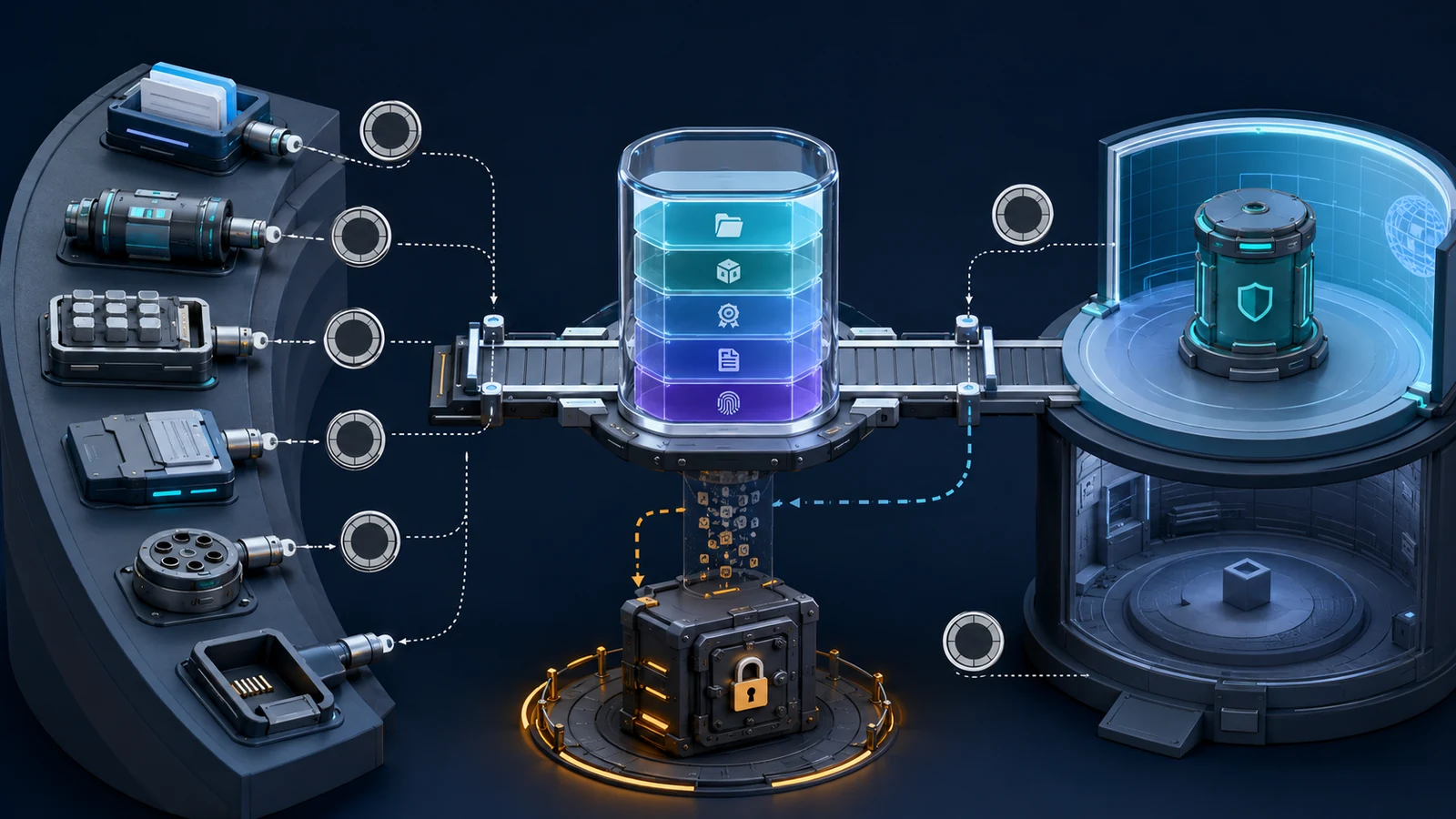
A practical handoff normally has five layers:
- Source: the code, notebook cells, configuration, queries, or analysis that the learner is allowed to retain.
- Inputs and outputs: permitted data, generated files, figures, logs, and checksums, with privacy and reuse boundaries.
- Environment: the language, runtime, package versions, setup commands, and external services needed to run the work.
- Provenance: timestamps, attribution, revisions, and a clear separation between learner-created work and provider or third-party material.
- Reproduction record: what opened, what ran, what changed, what failed, and how temporary resources were handled.
The Jupyter notebook format description shows why source, outputs, and metadata can be inspected as separate parts of a notebook. It does not promise that external datasets, package environments, secrets, remote services, or full revision history travel with the file. Portability therefore needs a declared boundary around every layer.
Free access is an access condition, not a quality verdict
The pilot used an existing signed-in Dataquest route and a new private DataLab workbook without an upgrade, purchase, or external data connection. Dataquest’s code-download guidance describes saving learner-written code, while DataLab’s workbook documentation describes a workspace that can contain notebooks, source, data, and configuration. Those documents help define the routes; the observations below show only what the selected free workflows returned.
Free availability can also be limited by account, quota, feature, region, or date. The DataLab pricing page describes a Starter route with bounded resources, but it is not a promise that every workbook, account, or future plan will expose the same allowance. A portable-work decision should record the exact access condition instead of turning “free” into a recommendation.
What the two exports actually contained
The two runs used identical evaluator-authored source bytes and the same embedded six-row synthetic CSV. The table describes the observed export package and the qualified local replay; it does not describe every export option offered by either provider.
On a narrow screen, scroll horizontally to read all columns.
| Surface | Observed route | Downloaded bundle | Fresh local replay | Qualified reading |
|---|---|---|---|---|
| Dataquest Guided Project | Jupyter File > Download | Notebook with the executed source, output, and metadata; no separate generated files in the download | Source ran successfully and reproduced the registered JSON result | Portable with qualification; generated files were reconstructed locally, while full cloud history and server termination were unverified |
| DataCamp DataLab Starter workbook | File > Download | ZIP with the notebook plus seven task files, including CSV, JSON, Markdown, requirements, environment, manifest, and PNG artifacts | Downloaded notebook source ran successfully and reproduced the registered JSON result | Portable with qualification; the native bundle included task files, while full revision history and automatic expiry were unverified |
Both cloud runs produced six rows, one missing value before normalization, grouped totals of alpha 30, beta 30, and gamma 90, and a total of 150. These values are synthetic test oracles, not learner, market, or platform statistics. The result supports a narrow portability observation: the same declared source can cross both sampled routes and reproduce its semantic output, but the shape of the exported artifact differs.
What remains unknown
- This is a purposive two-surface pilot with one task per surface and one shared Dataquest run; it is not a representative sample or a cross-provider ranking.
- The evaluator used AI assistance and synthetic input. No human beginner, learning cohort, course completion, skill gain, portfolio acceptance, or employment outcome was measured.
- No public Git push, full cloud revision-history transfer, external connected dataset, provider solution, or long-term archive was tested.
- Raw result-file hashes changed when the Windows replay used different line endings; parsed JSON values and the declared normalized hash matched. Chart pixel equality was not tested.
- Dataquest’s server termination and DataLab’s automatic expiry remain unverified. Private test workbooks and downloaded artifacts were retained for evidence; no deletion is claimed.
- Account entitlements, regional behavior, quotas, future UI changes, accessibility, latency, support, security, and reliability outside the sampled task remain unknown.
- The provider terms and documentation are evidence for a bounded research description, not individualized legal advice about ownership or reuse. Do not copy course-owned or third-party material merely because a file can be downloaded; the DataCamp Terms of Use illustrate why provider material and user-created work need separate review.
The practical conclusion is deliberately modest: test the smallest permitted artifact before investing in a longer course or subscription. Confirm the source of truth, export contents, dependencies, permissions, secret boundaries, history, cleanup, and the exact plan or account. If one of those is unknown, label it unknown instead of upgrading a documented route into a product verdict.
How the task was run and replayed
The pilot used a prospective protocol with the same source, input, assertions, export requirement, and ten evidence dimensions on both surfaces. It was designed to test artifact movement, not teaching effectiveness. No provider example, solution, course dataset, personal learner data, credential, or long-lived secret was used.
The controlled sequence
- Start with a blank notebook or workbook using the existing free-access route.
- Run an evaluator-authored task that strips and lowercases six synthetic category values, fills one missing number with zero, groups and sums the rows, and creates a chart.
- Record the visible runtime versions, output markers, file inventory, and any provider metadata that came with the export.
- Inspect the download for provider-owned content, private data, credentials, and unexpected files before using it elsewhere.
- Run only the exported task source in a fresh isolated local environment, with separate output directories and declared package versions.
- Compare semantic JSON results and retain differences in line endings, generated files, history, and cleanup instead of treating them as invisible details.
The local replay used Python’s virtual-environment documentation as the isolation reference. The cloud runtimes were not cloned exactly: Dataquest reported Python 3.11.0rc1, pandas 2.2.2, and matplotlib 3.9.1.post1; DataLab reported Python 3.12.11, pandas 2.3.1, and matplotlib 3.10.5. The replay environment used Python 3.12.1 with pandas 2.3.1 and matplotlib 3.10.5, so a matching semantic result is compatibility evidence, not exact environment replication.
How to interpret the result
“Portable with qualification” means the declared core artifact crossed the observed route and reproduced the registered result while material gaps stayed visible. It does not mean feature parity, a complete repository handoff, a durable archive, a course recommendation, or a promise that another account will have the same access. The same standard should be applied to any platform you are considering.
Sources
Official publisher pages checked September 14, 2026. The direct observations and local replay are described in the bounded research method above; source pages support the documented workflow and format boundaries.
- How do I download or save the code I’ve written? — Dataquest Support (checked September 14, 2026).
- DataLab pricing — DataCamp (checked September 14, 2026).
- Creating a workbook — DataCamp DataLab Docs (checked September 14, 2026).
- The notebook file format — Project Jupyter (checked September 14, 2026).
- venv — Creation of virtual environments — Python Documentation (checked September 14, 2026).
- Terms of Use — DataCamp (checked September 14, 2026).