
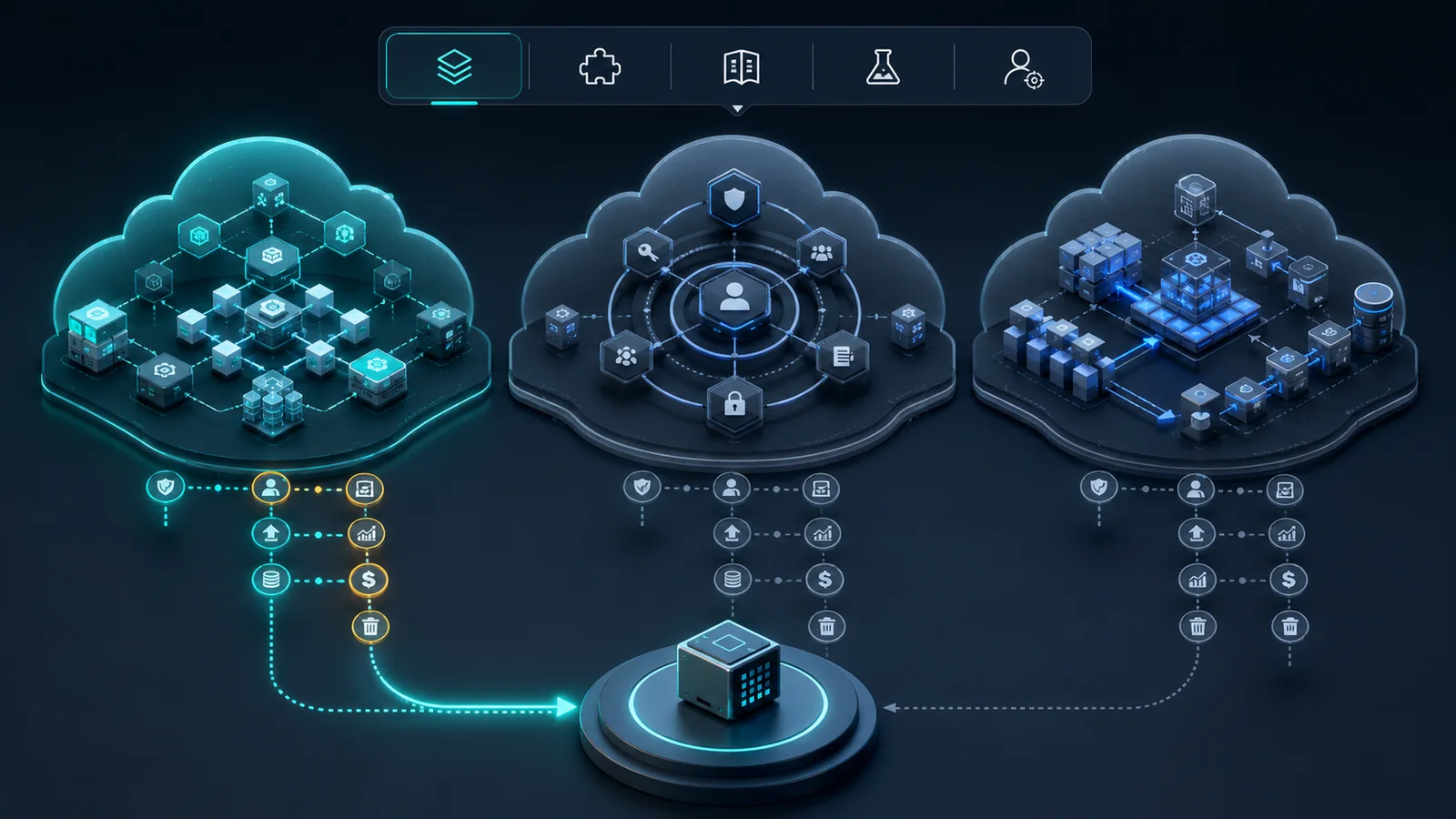
Quick answer
Choose the first cloud that matches the environment you can actually study, discuss, or use: a current employer stack, a course requirement, a project dependency, an approved lab, or a clearly stated role target. Then complete one small end-to-end workload before adding a second provider.
Start with AWS when your target context explicitly uses AWS or its role-based plans. Start with Azure when your context is Microsoft-centered or the first work you need to understand involves Azure identity, governance, infrastructure, or application delivery. Start with Google Cloud when the target environment or training requirement explicitly names Google Cloud and you can follow its infrastructure or application-development path. If no context favors one provider, any of the three can support a sound first loop; the important constraint is to keep the deliverable and evaluation criteria constant.
Your first checkpoint should prove that you can explain the responsibility boundary, configure least-privilege access, deploy a small service, connect storage or data, observe its behavior, estimate or inspect cost, and remove the resources. A foundational certificate can organize knowledge, but it is not a substitute for that operational evidence.
Evidence and scope
- Evidence profile
- E1 – official-source first-cloud learning-path comparison
- Information checked
- Primary market
- United States; English-language self-directed learning
- Direct evaluation
- Not performed
- Scope
- Current official learning paths, foundational and associate credential boundaries, role framing, shared-responsibility concepts, and a provider-neutral first-project method for AWS, Microsoft Azure, and Google Cloud
- Main limitation
- No account, console, subscription, sandbox, lab, course, support channel, exam workflow, billing flow, accessibility path, or end-to-end deployment was directly tested.
This comparison does not identify a universally best cloud, predict employer demand, rank certifications, compare market share, or promise a job outcome. It helps a learner choose one defensible starting context and a small proof-of-work checkpoint. See How we test for the site’s evidence profiles and testing boundaries.
Key facts
- AWS currently organizes training by roles including Cloud Practitioner, Solutions Architect, Developer, and DevOps Engineer.
- Microsoft Learn presents Azure fundamentals plus role-oriented administrator and developer routes.
- Google Cloud separates foundational cloud literacy from an operational Associate Cloud Engineer route and role-based infrastructure or application-development training.
- Foundational credentials describe knowledge boundaries; they do not independently demonstrate that a learner can operate a workload.
- Provider responsibility changes with the service model, so the learner must identify which identity, data, configuration, security, monitoring, and cost controls remain theirs.
- A useful first-cloud decision produces one auditable artifact and a re-evaluation date, not a permanent commitment to one vendor.
AWS describes role-based training entry points on its current Training and Certification page. Microsoft groups Azure training around fundamentals, adoption, and credentials on Microsoft Learn for Azure. Google Cloud distinguishes foundational, associate, and professional credentials on its credentials page.
Who should use this comparison
Use this page when you understand basic computing concepts but do not yet have a justified first-cloud focus. It is most useful if you can name one intended capability – such as deploying a web service, administering infrastructure, building a cloud application, or operating a delivery pipeline – and one context in which the work must run.
If you need to map the wider capability first, start with our cloud and DevOps learning-path guide, then return here to choose a provider context.
Do not use it as a substitute for a course comparison, subscription-pricing analysis, certification-objective mapping, or direct lab-platform review. It does not determine which provider has the largest market, which certification employers prefer, which free tier is cheapest, or whether a specific course teaches well. Those questions require separate current evidence and, in some cases, controlled access.
The three starting contexts at a glance
On a small screen, swipe or scroll the table horizontally to compare all columns.
| Provider | Choose it first when | Official starting routes | First evidence checkpoint | Do not infer |
|---|---|---|---|---|
| AWS | Your target workplace, project, course, or lab explicitly uses AWS, or an AWS role route matches the capability you named. | Cloud Essentials, Solutions Architect, Developer, or DevOps Engineering learning plans | Deploy and observe a small AWS workload, explain the customer responsibility, inspect cost, and remove it. | That AWS is universally easier, more employable, or the mandatory first provider |
| Microsoft Azure | Your context is Microsoft-centered, or the first work involves Azure administration, identity, governance, application delivery, or hybrid infrastructure. | Azure Fundamentals plus administrator and developer career paths | Deploy and manage a small Azure resource set, record identity and governance choices, inspect monitoring and cost, and clean up. | That an Azure Fundamentals credential proves administrator or developer competence |
| Google Cloud | Your project, employer, course, or approved lab explicitly uses Google Cloud, or its Cloud Engineer or Cloud Developer route matches the intended task. | Cloud Digital Leader, Cloud Engineer, infrastructure, and application-development paths | Deploy a small Google Cloud service, configure access, observe operations, inspect cost, and remove it. | That a business-literacy credential is equivalent to the Associate Cloud Engineer operating scope |
Takeaway: provider fit begins with a named context and deliverable. It is not established by logo familiarity, a broad catalog, or a certification badge alone.
How to choose your first cloud
1. Start with a real context
Write the strongest external constraint you have: current team stack, target project, approved course, lab availability, client environment, or job task. AWS currently offers a Cloud Essentials path intended to establish cloud benefits, core services, pricing, and security concepts. Review the AWS Cloud Essentials route. Use that evidence only when AWS is a relevant context; the existence of a beginner path does not establish universal priority.
2. Match one capability, not the whole catalog
For an architecture-oriented start, AWS describes a Solutions Architect plan around security, monitoring, automation, containers, and system design. Inspect the AWS Solutions Architect learning plan. For application work, AWS separately describes a Developer plan focused on developing, deploying, and modernizing applications. Inspect the AWS Developer learning plan. Keeping these routes separate prevents a learner from treating one provider name as a single curriculum.
Operations and delivery automation are another distinct capability. AWS describes its DevOps Engineering plan around deploying, managing, and monitoring cloud applications. Inspect the AWS DevOps route. This does not mean a beginner must start with a professional-level certification or learn every service named by the provider.
3. Use foundational credentials only for their stated scope
AWS Certified Cloud Practitioner validates a high-level understanding of AWS Cloud, services, and terminology and is described as suitable for learners without prior IT or cloud experience. Check the current Cloud Practitioner boundary. It can structure foundational study, but it does not demonstrate that the learner has deployed, secured, monitored, or recovered a workload.
AWS Certified Solutions Architect – Associate is positioned around cost- and performance-optimized solution design and currently recommends hands-on design experience. Check the current associate-level boundary. Do not collapse a foundational route and an associate route into a mandatory sequence: the appropriate next step depends on existing experience and the task to be performed.
4. Separate Azure fundamentals from role execution
Microsoft’s cloud-concepts path introduces deployment models, cloud benefits, service types, and shared responsibility. Review the Azure cloud-concepts path. The companion architecture-and-services path covers Azure infrastructure, compute, networking, storage, identity, access, and security. Review the Azure architecture and services path.
Microsoft Certified: Azure Fundamentals is a beginner credential for cloud concepts, Azure services, management, and governance. Check the current Azure Fundamentals scope. An administrator path then moves into implementing, managing, and monitoring identity, governance, storage, compute, and virtual networks. Review the administrator career path. A developer route emphasizes code, automation, safe deployment, operations, monitoring, and incident response. Review the developer career path.
5. Keep Google Cloud literacy and operations distinct
Google Cloud Digital Leader is framed around cloud basics, Google Cloud capabilities, business use cases, transformation, data, AI, infrastructure, security, and operations. Check the current Cloud Digital Leader scope. The Associate Cloud Engineer scope is operational: setting up an environment, implementing a solution, ensuring operations, and configuring access and security, with hands-on experience recommended. Check the current Associate Cloud Engineer boundary.
Google Cloud’s infrastructure training presents Cloud Engineer and Cloud Architect paths for deploying, monitoring, managing, migrating, and maintaining applications. Review the infrastructure training route. Its application-development training is aimed at designing, developing, deploying, and modernizing cloud applications. Review the application-development route.
6. Test the responsibility boundary before expanding
AWS states that customer responsibility varies by selected service and includes customer-controlled data, identity, operating systems, applications, and configurations as applicable. Review the AWS shared-responsibility model. Microsoft likewise distinguishes responsibilities across IaaS, PaaS, and SaaS while retaining customer responsibility for data, identities, accounts, and access management. Review Azure shared responsibility. The useful lesson is not to memorize one diagram; it is to annotate the exact service used in the first project.
7. Set a stop-and-review checkpoint
Use the first project to test whether you can make and explain identity, network, compute, storage, deployment, observability, reliability, security, and cost decisions. Google Cloud’s Well-Architected Framework organizes guidance around operational excellence, security, reliability, cost optimization, performance, and sustainability. Review the current framework. At the checkpoint, continue with the same provider only if the next task deepens the chosen capability; compare another provider only when a real requirement makes the difference material.
Official learning routes compared
On a small screen, swipe or scroll the table horizontally to compare all columns.
| Decision layer | AWS evidence | Azure evidence | Google Cloud evidence | Buyer interpretation |
|---|---|---|---|---|
| Foundational literacy | Cloud Essentials and Cloud Practitioner | Azure Fundamentals learning series and credential | Cloud Digital Leader | Useful for terminology and scope; not proof of operating skill |
| Infrastructure and design | Solutions Architect route | Administrator route plus architecture, management, and governance foundations | Cloud Engineer and Cloud Architect infrastructure paths | Choose when the first deliverable is an infrastructure or design artifact |
| Application development | Developer route | Developer career path | Cloud Developer application-modernization path | Choose when the first deliverable is a deployed application and its operational evidence |
| Operations and delivery | DevOps Engineering route | Administrator and developer responsibilities include monitoring, automation, deployment, and incident work | Associate Cloud Engineer scope includes operations, access, and security | Do not start here merely because “DevOps” appears in a title; verify foundations and an end-to-end workload first |
| Architecture quality | Shared responsibility and role-specific architecture training | Shared responsibility and Azure management/governance foundations | Well-Architected Framework pillars | Use a common review checklist rather than provider marketing language |
The rows are intentionally not scores. The providers publish different taxonomies, course catalogs, credentials, labs, and product abstractions. A fair first-path decision compares the same buyer job and evidence checkpoint, not the number of services or learning items listed.
Alternatives to choosing a provider now
- Build portable foundations first. Strengthen Linux, networking, identity, Git, scripting, application configuration, logs, and basic cost reasoning before opening a provider account.
- Use architecture-only exercises. Draw a small workload, identify trust boundaries, estimate dependencies, define failure signals, and compare how each provider would express the same design without deploying it.
- Delay certification. Use official learning paths for orientation, then decide whether an exam is material to the intended capability or merely adds another commitment.
- Follow the required environment. When a school, employer, approved lab, or client already defines the provider, treat that as the anchor and postpone abstract provider comparison.
- Stop before multicloud. A second provider is justified when portability, migration, resilience, procurement, or a real job task requires it – not because three beginner catalogs exist.
Unknowns and limitations
This is an E1 official-source comparison. No course quality, lab reliability, support response, account onboarding, free-credit eligibility, regional service availability, quota, billing alert, checkout total, tax, refund rule, accessibility behavior, device fit, exam scheduling, or credential-recognition claim was tested.
Provider catalogs, certification guides, learning-platform interfaces, free offers, service names, and role descriptions can change. The current Google Cloud Digital Leader page, for example, exposes current and upcoming exam-guide dates, which shows why a learner must recheck effective dates rather than assume one static outline. The article does not quote prices or recommend an exam purchase.
The comparison also does not measure employer demand, market share, salary, hiring probability, completion time, teaching effectiveness, or learner outcomes. A provider may be the practical first choice because of context even when another catalog appears broader. Conversely, a familiar logo is not enough reason to choose a path if the learner cannot name a first deliverable.
Make a bounded starting decision
- Write one capability: deploy, administer, develop, operate, or design.
- Write the strongest context constraint: employer, project, course, lab, or target role.
- Select one provider and one official route that matches both.
- Define a small workload with identity, networking, compute or managed runtime, storage or data, monitoring, cost review, and cleanup.
- Record the provider-responsibility boundary for every service used.
- Save a sanitized architecture diagram, deployment record, observation note, and cleanup proof.
- At the checkpoint, decide: deepen the same capability, change the provider because the context changed, or return to portable foundations.
Decision rule: choose the provider that lets you produce the most relevant first evidence with the fewest invented assumptions. Revisit the choice after the artifact exists.
Methodology
We reviewed current official training, certification, role-path, responsibility, and architecture pages from AWS, Microsoft, and Google Cloud on September 11, 2026. The comparison denominator was held constant: target context, intended capability, route level, first evidence checkpoint, responsibility boundary, and stop condition.
We did not score providers because no approved weighting model, representative direct evaluation, or common account-level test exists for this article. We preserved foundational versus operational credential distinctions, did not infer employer preference, and treated every planned internal transition as inactive until both pages are live and separately approved.
Sources
- AWS, Training and Certification, checked September 11, 2026.
- AWS, Cloud Practitioner / Cloud Essentials learning plan, checked September 11, 2026.
- AWS, Solutions Architect learning plan, checked September 11, 2026.
- AWS, Developer learning plan, checked September 11, 2026.
- AWS, DevOps Engineering learning plan, checked September 11, 2026.
- AWS, AWS Certified Cloud Practitioner, checked September 11, 2026.
- AWS, AWS Certified Solutions Architect – Associate, checked September 11, 2026.
- AWS, Shared Responsibility Model, checked September 11, 2026.
- Microsoft, Training for Azure, checked September 11, 2026.
- Microsoft, Describe cloud concepts, checked September 11, 2026.
- Microsoft, Describe Azure architecture and services, checked September 11, 2026.
- Microsoft, Microsoft Certified: Azure Fundamentals, checked September 11, 2026.
- Microsoft, Training for Administrators, checked September 11, 2026.
- Microsoft, Training for Developers, checked September 11, 2026.
- Microsoft, Shared responsibility in the cloud, checked September 11, 2026.
- Google Cloud, Credentials: badges and certifications, checked September 11, 2026.
- Google Cloud, Cloud Digital Leader, checked September 11, 2026.
- Google Cloud, Associate Cloud Engineer, checked September 11, 2026.
- Google Cloud, Cloud Infrastructure and Architecture training, checked September 11, 2026.
- Google Cloud, Application Development training, checked September 11, 2026.
- Google Cloud, Well-Architected Framework, checked September 11, 2026.