
Quick answer
Evidence profile: E1 source-led research, so this is a documentation-based Coursera route analysis rather than a direct-use review. Coursera can fit a learner who wants a course or program from a named university or company, a structured multi-course sequence, a paid completion certificate, or an online university pathway. The key decision is not simply whether the catalog is large. It is whether the exact program type, provider, prerequisites, assessment model, credential issuer, access route, price, and cancellation terms match your goal.
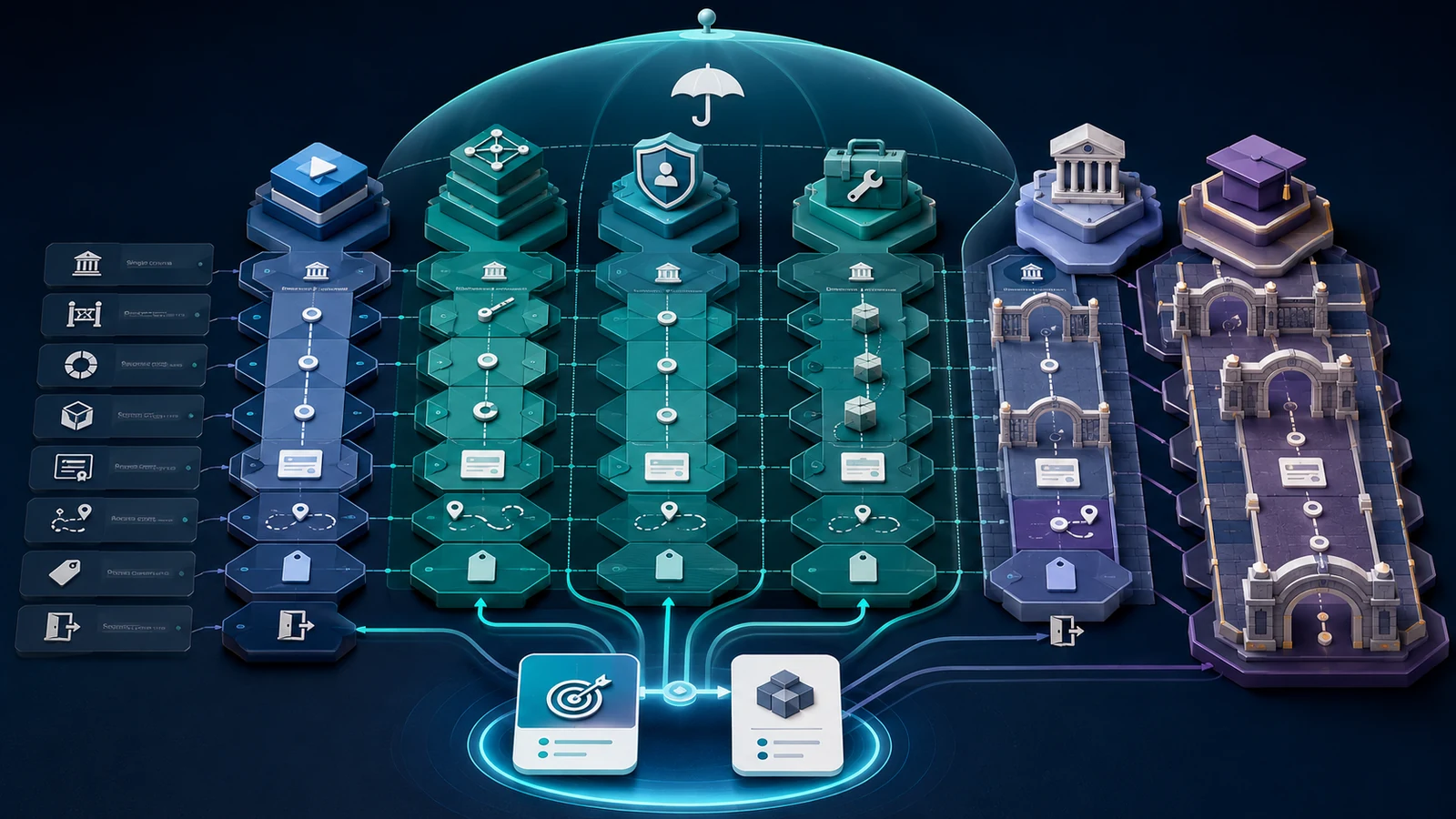
Start with the smallest route that can produce the evidence you need: preview or audit when available, one course for a bounded capability, a Specialization or Professional Certificate for a sequence, a Guided Project for a short tool task, or a university program when admissions and academic credit are material. Treat Coursera Plus as an access bundle, not proof that every desired program is included or that every certificate has the same meaning.
Evidence and scope
- Evidence profile
- E1 – current official public-source review
- Information checked
- Target market
- United States primary; individual technical learners comparing a specific Coursera route, program, or Plus subscription
- Unit of analysis
- One exact Coursera offering and one declared learning or credential objective-not Coursera as a uniform curriculum or a catalog-wide quality score
- Direct evaluation
- Not performed
- Main limitation
- No account, enrollment, search, preview, assessment, certificate, support, accessibility, device, cancellation, refund, degree-admission, or Udemy-integration workflow was directly evaluated.
Coursera completed its combination with Udemy on . The transaction changes the corporate context, but the official notices do not establish unified learner accounts, catalogs, purchases, subscriptions, progress, certificates, or support. This article therefore analyzes the current Coursera consumer surface as documented and keeps future cross-platform integration as an unknown. See How we test for the evidence labels and testing boundaries used here.
Key facts
- Coursera documents a catalog spanning courses, Specializations, Professional Certificates, university certificates, Guided Projects, and degrees. These are different products, not interchangeable labels.
- Coursera and Udemy are now one company, but the official combination notices do not establish a single learner account, unified catalog, shared purchase history, or reciprocal subscription access.
- The Coursera Plus page viewed in a United States context on September 12, 2026 displayed a limited $35-per-month promotion for the first three months (regularly $59) ending September 23, 2026, and also listed $399 per year for the annual plan. The page says local currency and pricing are shown at checkout outside the United States; treat the display as a dated promotion, not a universal quote.
- Coursera’s current terms state that certificates cannot be earned during a subscription free trial. The trial must end or be ended early with consent to the first charge before a certificate can be issued.
- Subscriptions renew automatically unless canceled. Cancellation stops future billing but normally takes effect at the end of the current billing period.
- Free preview, audit, Full Course No Certificate, financial aid, and paid certificate options vary by exact course or program. A catalog-level statement does not guarantee one option on every page.
- A Professional Certificate is a completion credential, not automatically a professional certification, license, academic degree, or guarantee of employer recognition.
- Degree and university certificate admissions, tuition, refund, transfer-credit, and completion rules belong to the issuing institution and exact program.
- Guided Projects use a short, step-by-step applied format in a preconfigured workspace, but exact projects can have desktop-only, no-audit, or no-financial-aid limits.
- Language, AI assistance, translations, assessment type, device access, and included-with-subscription status must be checked on the exact program page.
The current product family is documented across Coursera’s company overview, consumer home page, and catalog guide. These pages support the program-type distinctions, but their marketing language does not establish personal fit, teaching quality, credential value, or career outcomes.
Who should use this analysis
Use this analysis when you are considering Coursera for a technical course, a multi-course learning sequence, a company-issued Professional Certificate, or an online university pathway and need to decide what you are actually buying. It is especially useful when several pages use similar phrases-course, certificate, specialization, project, degree, “included with,” or free trial-but lead to different access and credential rules.
This page does not decide whether Coursera is universally “worth it.” It does not compare Coursera with Udemy, edX, LinkedIn Learning, or a specific alternative; it does not evaluate an exact instructor or program; and it does not infer that a certificate changes hiring, salary, licensure, academic standing, or admission prospects. The buyer task is narrower: choose the right Coursera route for one defined objective, then verify the exact page and terms before enrolling.
Coursera describes itself as working with university and industry partners to deliver courses, Specializations, Professional Certificates, and degrees. Coursera’s program-type explainer is useful for orientation, but the exact program page remains authoritative for current provider, sequence, assessment, language, schedule, and certificate details.
Choose the right Coursera route
On a small screen, swipe or scroll the table horizontally to compare all columns.
| Route | Primary job | Credential or access result | Verify before enrolling |
|---|---|---|---|
| Preview, audit, or free-access course | Inspect content or learn a bounded topic with minimal commitment | May provide videos and readings while excluding graded work, feedback, or certificate | Whether the exact course offers preview, audit, or Full Course No Certificate; what remains locked |
| Paid course | Complete one defined course with graded access | Course Certificate when the exact paid requirements are completed | Provider, prerequisites, assessment type, refund window, certificate issuer, and current price |
| Specialization | Follow a related series around one subject | Course certificates plus a Specialization Certificate when the sequence is completed | Course count, order, capstone or applied assignment, monthly billing, and cancellation condition |
| Professional Certificate | Complete a provider-designed career or role sequence | Completion credential from the offering institution or company | Exact issuer, experience level, included projects, monthly cost, expected study load, and whether it is a certificate rather than certification |
| Guided Project | Practice one short tool or workflow task | Short applied experience and shareable certificate when offered | Desktop requirement, cloud workspace, audit and aid availability, data handling, and whether the task produces reusable work |
| University certificate or degree | Pursue an institution-issued academic or graduate credential | Credential issued under the university’s program rules | Admissions, credit, tuition, deadlines, residency or identity requirements, refund policy, and transfer rules |
| Coursera Plus | Access multiple included courses and programs under one subscription | Paid access and certificates for eligible included content after the trial boundary | Whether every intended program is marked included, billing cycle, renewal, trial end, and annual refund deadline |
Takeaway: select the program type before comparing catalog size or subscription price. The correct route is the smallest one that includes the required learning sequence, assessment, credential, and access period.
Inspect the exact program before committing
1. Verify the provider and the award
Write down the exact university, company, or instructor shown on the page and the exact credential label. A Course Certificate, Specialization Certificate, Professional Certificate, university certificate, and degree have different issuers and requirements. Coursera’s current Professional Certificate explainer explicitly distinguishes a professional certificate from a certification. Do not shorten both to “certification” in your decision record.
University certificate pages state that the credential is issued by the university and is not co-branded with Coursera. The current university certificate directory should be treated separately from ordinary course certificates and company Professional Certificates.
2. Verify level, prerequisites, and entry route
Do not rely only on a “beginner” label. Check recommended experience, assumed tools, mathematics, programming, language, hardware, and any provider-specific entry condition. Degree pages may use applications, transfer credits, performance-based admission, or fixed term deadlines. Coursera’s bachelor’s degree directory and computer science degree directory illustrate that admissions and credit routes vary by university and program.
3. Map the actual sequence
Record every required course, capstone, project, and assessment rather than relying on the program title. Coursera describes Specializations as course series that can include capstone or applied work, while Professional Certificates are provider-led training sequences. The Professional Certificate directory shows current program-level workload and price framing, but each exact program can differ.
- List the required courses and whether order is enforced or merely recommended.
- Identify graded quizzes, coding assignments, peer review, projects, exams, or identity checks.
- Mark any separate capstone enrollment, external tool, cloud account, software license, or local setup.
- Record the evidence artifact you expect to retain: report, notebook, repository, design, assessment result, or certificate.
4. Check language, schedule, and current inclusion
Coursera has documented AI-powered translations across parts of the platform, but language coverage remains program-specific. The translation expansion announcement is evidence of a platform capability, not a guarantee that every current video, reading, quiz, assignment, or certificate is available in your preferred language. Confirm the language list and subtitles on the exact program page.
Coursera Plus currently includes an additional microlearning surface called Ollie for Plus subscribers, based on a select partner set. The June 2026 Ollie announcement does not establish that a specific course, credential, or assignment is available in that app. Treat it as a separate access feature, not a substitute for reviewing the target program.
Check practice, assessment, and evidence
Separate content access from graded access
A free or no-certificate route can be useful for inspecting videos and readings, but it may omit graded assignments, certificates, or instructor feedback. Coursera’s current information-technology catalog guidance describes audit access in those bounded terms. A separate current course page shows that some programs may offer Full Course No Certificate and financial aid when available. Review the exact course access FAQ rather than assuming the same options exist everywhere.
Identify the practice model
“Hands-on” can mean different things: a guided browser workspace, a notebook, a peer-reviewed submission, an automatically graded quiz, a coding exercise, or a provider capstone. Guided Projects are documented as short, step-by-step tasks in a preconfigured environment. Coursera’s Guided Projects overview supports that model description, not a quality or portability verdict.
Exact project limits matter. One current Guided Project page states that the workspace is browser-based, auditing and financial aid are unavailable, and the project is completed in a split-screen experience. The project FAQ is a reminder to verify desktop requirements, cloud workspace behavior, file export, retention, and whether the finished work can be reused outside the guided environment.
Preserve authorship and privacy boundaries
Record what work you wrote, what came from course instructions, and what was generated or graded by an AI feature. Some current course pages label assignments as AI-graded and link that processing to Coursera’s privacy notice. Coursera’s Privacy Notice should be reviewed when personal data, uploaded work, identity verification, external tools, or AI assistance is material. Do not upload confidential employer data, credentials, private repositories, or restricted datasets merely because a course assignment requests an example.
Verify access, price, renewal, and refunds
Current Coursera Plus snapshot
In a United States view checked on , the Coursera Plus page displayed a limited promotion of $35 per month for the first three months (regularly $59), with the offer ending September 23, 2026, and listed $399 per year for annual Plus. The page also describes a seven-day monthly free trial, a 14-day annual refund window, more than 10,000 included courses and programs, and exclusions that must be checked on the exact offering. Check the live Coursera Plus page immediately before purchase. Treat those figures as a dated display, not a final invoice or guarantee that every desired program is included.
Trial and certificate boundary
Coursera’s current terms say certificates cannot be earned during a subscription free trial. To receive a certificate, the learner must either consent to the first charge by ending the trial early or let the trial expire without canceling. This means a seven-day trial can inspect a learning route, but it should not be treated as a certificate-completion window.
Billing and cancellation matrix
On a small screen, swipe or scroll the table horizontally to compare all columns.
| Access route | Current documented boundary | Buyer record to keep |
|---|---|---|
| Coursera Plus monthly | The page displayed $35 per month for the first three months under a limited offer (regularly $59); it states automatic renewal at $59 per month plus applicable taxes after the offer, with a trial where offered and limited subscription refunds | Trial end, first charge, renewal date, included programs, cancellation confirmation |
| Coursera Plus annual | Displayed at $399 per year; the terms provide a 14-day refund period for the first annual purchase and no refund for annual renewal charges | Purchase date, refund deadline, renewal date, exact included-program checks |
| One-time course or Specialization purchase | Refund may be available within seven days or before earning a certificate, whichever comes first | Charge date, certificate status, content accessed, refund-request timestamp |
| Program subscription | Automatically renews until canceled; cancellation normally preserves access to the end of the paid period and stops future billing | Billing cadence, current price, program completion rule, cancellation state |
| Degree or university certificate | Admissions, tuition, refunds, and graduation rules are set by the content provider and exact program | Institution policy, term dates, tuition schedule, withdrawal and refund rules |
| App-store or third-party purchase | Third-party marketplace refund policy can control instead of Coursera’s direct process | Payment channel, marketplace receipt, subscription owner, support route |
The rules above come from Coursera’s current Terms of Use and Refund and Cancellation Policy. Prices, promotions, taxes, currency, catalog inclusion, and eligibility can vary. Cancellation is not the same as a refund request, and a displayed monthly equivalent is not necessarily the amount charged that day.
Use a lower-commitment route when possible
A Coursera Plus subscription or long program is not always the correct first step. Depending on the unresolved question, consider one of these narrower routes:
- Preview the first module or use an audit option when the exact course offers it.
- Choose one paid course instead of a multi-course sequence when the target capability is narrow.
- Use Full Course No Certificate when available and the graded learning experience matters more than the credential.
- Use one Guided Project to inspect a tool workflow, while accepting its workspace and portability limits.
- Apply for financial aid only where the exact program page offers it; do not assume coverage across a whole series.
- Use direct university or provider documentation when the course mainly restates a standard, framework, or software workflow.
- Choose a separate course marketplace when one instructor-led course fits better than a partner credential or bundled subscription.
- Defer enrollment when admissions, accessibility, language, device, refund, credit, or employer-recognition requirements remain material and unverified.
Coursera’s catalog page documents both free-audit and paid routes, but availability is exact-page dependent. Use the catalog as discovery evidence, then verify the enrollment screen and current terms before treating an option as available.
Unknowns and limitations
- No Coursera or Udemy account, search result, preview, course, Guided Project, assignment, peer review, AI feature, certificate, or learner-support workflow was directly used.
- The completed corporate combination does not establish unified consumer catalogs, accounts, purchases, subscriptions, progress, certificates, or support. Those integrations remain unknown until documented or observed.
- Coursera Plus inclusion is program-specific. The 10,000-plus catalog statement does not establish that a particular degree, university certificate, course, Specialization, or Professional Certificate is included.
- Displayed prices may vary by location, currency, promotion, tax, account state, payment channel, and future plan changes.
- Course labels, workloads, languages, assessment counts, instructors, dates, and program sequences can change.
- No teaching-quality, peer-feedback, AI-grading, support-response, reliability, accessibility, mobile, offline, or device-compatibility conclusion was established.
- A Course Certificate, Specialization Certificate, Professional Certificate, university certificate, certification, and degree are not interchangeable. Recognition, credit, licensure, and admission decisions remain external to this article.
- No job-readiness, hiring, salary, promotion, exam-pass, academic-credit-transfer, or return-on-investment claim is approved.
- No affiliate relationship, sponsored placement, commission, score, rank, winner, or product verdict is included.
Recheck entity status, Plus pricing, catalog inclusion, enrollment options, exact program pages, and terms after , or earlier if Coursera announces a material Udemy integration, plan change, or policy update.
Build a one-page enrollment record
- Objective: one capability, credential, academic pathway, or project outcome.
- Exact route: course, Specialization, Professional Certificate, Guided Project, university certificate, degree, or Plus bundle.
- Provider and issuer: the named university, company, or instructor and the exact award label.
- Prerequisites: experience, tools, mathematics, programming, language, device, and external-account requirements.
- Sequence and assessment: required courses, projects, peer review, quizzes, exams, AI grading, or identity checks.
- Evidence artifact: the work, result, or credential you expect to retain and what may remain inside the platform.
- Access route: preview, audit, no-certificate, one-time purchase, program subscription, Plus, financial aid, or institution billing.
- Commercial record: market, currency, full charge, trial end, refund deadline, renewal date, tax, and payment channel.
- Unknowns: catalog inclusion, language, accessibility, support, transfer credit, recognition, or merger integration that still matters.
- Decision: enroll, inspect first, choose a narrower route, compare another model, or defer.
The record is complete when the exact program page and current terms answer every hard requirement. A large catalog or well-known provider should not substitute for a defined learning objective, a verified access route, and a clear exit condition.
Methodology
This E1 platform analysis used 20 official Coursera sources checked on . The source set covers current company status, catalog and program types, Coursera Plus, refund and cancellation rules, Professional Certificates, university certificates, degrees, Guided Projects, course-access options, financial aid references, privacy, translations, and the Ollie Plus feature.
Twenty approved claims were mapped to the article. Official pages support only their documented product, access, credential, and policy statements. Marketing claims about career value, employer recognition, outcomes, and teaching quality were not converted into editorial conclusions. A dated price display was retained as a snapshot, not a checkout quote.
No account, enrollment, payment, learner journey, assignment, certificate, support, accessibility, or cross-platform integration was directly tested. The editorial conclusion is limited to a buyer method: identify the exact route, provider, credential, prerequisites, assessment, access model, commercial terms, evidence artifact, and unresolved unknowns before paying.
Sources
- Coursera Completes Combination with Udemy to Build the World’s Most Comprehensive Skills Platform, Coursera Investor Relations. Checked September 12, 2026.
- About Coursera, Coursera. Checked September 12, 2026.
- Coursera: Courses, Professional Certificates, and Degrees Online, Coursera. Checked September 12, 2026.
- Coursera Online Course Catalog by Topic and Skill, Coursera. Checked September 12, 2026.
- Coursera Plus, Coursera. Checked September 12, 2026.
- Terms of Use and Refund and Cancellation Policy, Coursera. Effective January 1, 2026; checked September 12, 2026.
- What Is Coursera?, Coursera. Checked September 12, 2026.
- Launch Your Career with Professional Certificates, Coursera. Checked September 12, 2026.
- What Is a Professional Certificate?, Coursera. Checked September 12, 2026.
- Online University Certificate Programs, Coursera. Checked September 12, 2026.
- Online Bachelor’s Degree Programs, Coursera. Checked September 12, 2026.
- Online Computer Science Degrees, Coursera. Checked September 12, 2026.
- Guided Projects, Coursera for Campus. Checked September 12, 2026.
- Introduction to Project Management, Coursera Guided Project. Checked September 12, 2026.
- An Introduction to Accessibility and Inclusive Design, Coursera. Checked September 12, 2026.
- Information Technology Online Courses, Coursera. Checked September 12, 2026.
- Privacy Notice, Coursera. Checked September 12, 2026.
- Coursera Expands AI-Powered Translations to 17 Popular Languages, Coursera Blog. Published December 5, 2023; checked September 12, 2026.
- Introducing Ollie: A New Microlearning App for Coursera Plus, Coursera Blog. Published June 3, 2026; checked September 12, 2026.
- Coursera and Udemy Are Now One Company, Coursera Blog. Published May 11, 2026; checked September 12, 2026.