
Quick answer
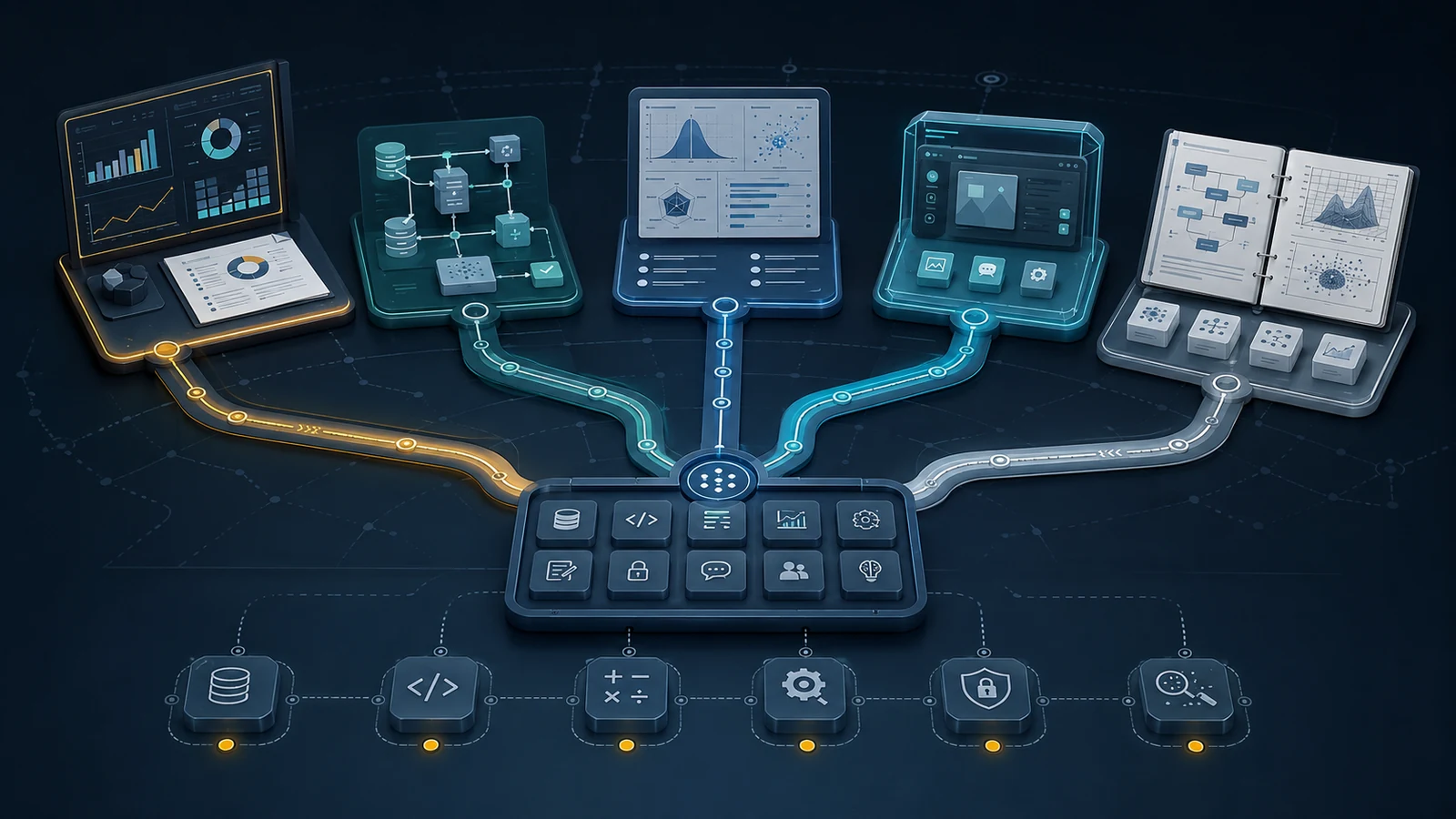
Evidence profile: E1 source-led research, so this is a documentation-based path guide rather than a tested course review. Choose a first path by naming the capability you want to demonstrate, not by trying to “learn data science and AI” as one undivided subject. Start with the smallest route that produces one inspectable artifact: an analysis and decision memo, a tested data pipeline, a baseline predictive model, a narrowly evaluated AI application, or a reproducible research exercise.
For many career changers, analytics or business intelligence is the lowest-risk entry when the immediate work is querying, cleaning, summarizing, visualizing, and explaining data. Data engineering is a different route centered on reliable data movement and models. Predictive machine learning adds problem framing, statistical reasoning, baselines, and evaluation. AI application development can begin with pretrained models, but it still requires software, data, evaluation, privacy, and risk controls. Research-oriented deep learning normally belongs later, after programming, mathematical, and machine-learning foundations are usable.
Evidence and scope
- Evidence profile
- E1 – current official public-source review
- Information checked
- Target market
- United States; English-language beginner to intermediate career changers
- Scope
- A capability-first method for choosing among analytics and business intelligence, data engineering, predictive machine learning, AI application development, and research-oriented deep learning
- Direct evaluation
- Not performed
- Main limitation
- No course, platform, notebook, dataset, model, pipeline, assessment, portfolio, hiring process, salary outcome, accessibility flow, support channel, or study schedule was directly evaluated.
Occupational descriptions establish broad work patterns, while technical documentation establishes prerequisite and workflow boundaries. Neither establishes teaching quality, personal fit, completion time, or hiring value. The five routes are planning categories rather than a universal ladder. See How we test for the evidence labels and testing boundaries used here.
Key facts before choosing a path
- Data-science work can include identifying useful data, collecting and cleaning it, analyzing it, building and validating models, visualizing results, and communicating recommendations.
- Business-intelligence work emphasizes queries, reports, dashboards, trend analysis, and decision support; it is not simply a reduced version of machine learning.
- Data-engineering and warehousing work emphasizes source systems, loading and transformation, models, quality, and dependable delivery.
- Predictive machine learning begins with a measurable problem and representative data, not with choosing the most advanced algorithm.
- Using a pretrained model in an application is different from training a foundation model or conducting machine-learning research.
- Python, SQL, tabular-data tools, notebooks, statistics, software practices, and domain knowledge serve different roles. No learner needs every tool before producing a first useful artifact.
- A certificate, notebook, repository, badge, or course-completion record can document work completed. None proves job readiness, hiring, salary, promotion, or long-term performance by itself.
The broad occupational boundaries above are supported by the U.S. Bureau of Labor Statistics profile for data scientists, O*NET’s Data Scientists summary, O*NET’s Business Intelligence Analysts summary, and O*NET’s Data Warehousing Specialists summary.
Start with your transferable assets, not a blank-slate identity
A career changer rarely begins from zero. Operations experience can supply process knowledge; finance or marketing can supply business questions and metric literacy; software experience can supply version control, testing, and deployment habits; research experience can supply experimental design and uncertainty; and subject-matter work can supply the context needed to detect implausible results. Treat those assets as part of the path decision rather than discarding them because they are not labeled “AI.”
Before selecting a course sequence, write an inventory in five columns: domain knowledge, programming, data and SQL, quantitative reasoning, and communication. Mark each item as usable now, needs refresh, or not yet developed. The purpose is not to create a self-score. It is to identify which prerequisite blocks the first artifact and which existing strength can make that artifact relevant.
Education profiles are context, not admission rules. The Bureau of Labor Statistics lists a bachelor’s degree as typical entry-level education for data scientists and notes that some employers prefer advanced degrees. Its profile for computer and information research scientists generally lists a master’s degree. These descriptions summarize observed occupations; they do not establish that every role, employer, or learner requires the same credential. The research-scientist profile helps mark the boundary between application-oriented learning and advanced research, not a guaranteed career threshold.
Choose the route that matches the next capability
On a small screen, swipe or scroll the table horizontally to compare all columns.
| Route | First capability | First evidence artifact | Prerequisite checkpoint | Defer or redirect when |
|---|---|---|---|---|
| Analytics and business intelligence | Query, clean, summarize, visualize, and explain a decision-relevant dataset | Documented SQL queries, a reproducible analysis, a dashboard or report, and a short decision memo | Basic spreadsheet reasoning, data types, SQL concepts, and clear written explanation | The intended work is building production data systems or predictive models rather than answering a defined business question |
| Data engineering | Move and transform data reliably between defined sources and destinations | A small ingestion and transformation pipeline with a data model, tests, quality checks, and operating notes | SQL, Python or another programming language, file and database concepts, and basic software practices | You cannot yet explain the source, target, schema, failure modes, or quality rules |
| Predictive machine learning | Frame a measurable prediction problem, establish a baseline, evaluate unseen data, and analyze errors | A notebook or project with a data statement, baseline, train/test boundary, metrics, error analysis, and limitations | Python, arrays and tables, algebra, descriptive statistics, and a usable problem definition | The data is not representative, the target is not measurable, or a simple non-ML rule has not been considered |
| AI application development | Integrate a pretrained model into a narrow workflow and evaluate whether it helps | A small application with an evaluation set, failure examples, data-handling notes, model/version record, and fallback behavior | Programming, API or library use, product requirements, test cases, privacy awareness, and cost/latency boundaries | The task is vague, outputs cannot be evaluated, sensitive data has no approved handling path, or a non-AI solution is sufficient |
| Research and deep learning | Understand, reproduce, or extend a method under explicit experimental controls | A reproducible experiment with assumptions, training and evaluation records, comparisons, uncertainty, and deviations | Comfortable Python, linear algebra, probability/statistics, core machine learning, and experiment discipline | Framework syntax is masking missing ML foundations or the goal can be met with a pretrained model or simpler method |
Takeaway: the routes can connect, but they are not a compulsory ladder. An analyst may never need deep learning; an experienced software engineer may enter through AI application development and backfill statistics; a domain researcher may need modeling earlier but still require data and evaluation foundations.
Apply the five-part path decision
1. Name an observable capability
Replace “become a data scientist” with an action that can be inspected: write a reliable query and explain the result; transform raw files into validated tables; predict a defined outcome and evaluate the errors; or integrate a pretrained model into a bounded workflow. Occupational titles vary, while an observable capability can guide prerequisites, practice, and evidence.
2. Define the problem before the tool
Google’s machine-learning problem-framing guidance starts with the non-ML goal, asks whether the problem needs predictive ML, generative AI, or a simpler approach, and requires trustworthy, representative data. The problem-framing guide supports delaying model selection until the target, decision, data, and success condition are explicit.
3. Audit only the prerequisites that block the next artifact
Do not spend months “finishing prerequisites” without a target. The Machine Learning Crash Course prerequisite page lists Python, NumPy, pandas, algebra, and statistics, while treating calculus as optional for advanced topics. That is useful for an ML route, not a requirement for every analytics or data-engineering project.
4. Select one first artifact and one evaluation rule
An artifact should make the work reviewable without pretending it proves employability. For analytics, preserve the question, query, transformations, visualization, and interpretation. For data engineering, preserve the schema, pipeline, tests, quality conditions, and recovery notes. For ML, preserve the baseline, data split, metrics, and error analysis. For an AI application, preserve test cases, failure examples, model/version information, privacy choices, and fallback behavior.
5. Define a stop, defer, or redirect condition
Stop adding courses when the next capability is still undefined. Defer ML when the target cannot be measured or the dataset is not usable. Redirect from deep learning when a pretrained model or conventional method answers the question. Pause any project when data rights, privacy, security, or evaluation controls are unclear. A path decision is useful when it can say “not yet” or “not this route,” not only “continue.”
Sequence the foundations by route
Programming and Python
Python is common across the routes, but its official tutorial says it is intended for programmers new to Python rather than people new to programming. The Python tutorial is therefore a language guide, not proof that programming fundamentals can be skipped. A beginner may need variables, control flow, functions, files, errors, environments, and debugging before relying on data libraries.
SQL and relational thinking
SQL is a strong early foundation for analytics, business intelligence, and data engineering. The current PostgreSQL tutorial introduces relational concepts and SQL without assuming programming experience. Learn to select, filter, join, aggregate, and reason about tables before treating a dashboard or model as trustworthy.
Arrays, tables, and notebooks
NumPy’s beginner guide introduces arrays and numerical operations, while pandas getting-started documentation covers tabular data and common file and database formats. The Jupyter project documents notebooks that combine code, narrative, equations, and output. Use that combination to expose decisions and limitations, not merely to display a final chart.
Modeling and evaluation
The scikit-learn getting-started guide demonstrates estimators, preprocessing, pipelines, train/test separation, cross-validation, and evaluation. A model that fits training data is not a completed learning artifact. The record should show how unseen data was handled, what metric represents the problem, and where errors concentrate.
Deep learning and pretrained models
PyTorch’s Learn the Basics path describes a complete machine-learning workflow and assumes familiarity with Python and deep-learning concepts. By contrast, the Transformers pipeline tutorial shows how pretrained models can support inference tasks. These routes answer different questions: learning model training and internals versus integrating an existing model into an evaluated application.
Pipelines, privacy, and AI risk
Data work becomes operational when inputs, transformations, dependencies, retries, and outputs must be coordinated. The Apache Airflow core-concepts overview describes workflows through directed acyclic graphs, tasks, and data flow. For data and AI projects, technical execution also needs risk boundaries. The NIST AI Risk Management Framework addresses trustworthy design, development, use, and evaluation, while the NIST Privacy Framework provides a structure for identifying and managing privacy risk. These frameworks do not certify an individual project; they supply questions that a learning artifact should not ignore.
Treat artifacts, certificates, and occupational outcomes as different evidence
A course certificate records completion under the provider’s rules. A notebook records an analysis. A repository records files and changes. A dashboard records one presentation layer. A model metric records performance under a stated dataset and procedure. None automatically establishes independent authorship, production reliability, responsible data handling, communication skill, or performance in another context.
A useful public or private portfolio record should make the project understandable: purpose, data source and permitted use, setup, method, assumptions, results, limitations, and how to reproduce or review it. GitHub’s README guidance describes a README as a place to explain what a project does, why it is useful, how to begin, where to get help, and who maintains it. That is a documentation baseline, not a hiring guarantee.
For a separate method for checking career-outcome evidence, see the career-outcome claims guide. This article does not make claims about placement rates, salaries, promotions, credential recognition, interview success, or time to employment. Occupational descriptions and typical education levels are context for scoping a route; they are not forecasts for an individual learner.
Unknowns and limitations
- No course, curriculum, platform, assessment, instructor, support channel, community, lab, notebook, cloud account, dataset, pipeline, model, or portfolio workflow was directly evaluated.
- The five routes are planning categories, not a complete occupational taxonomy. Job titles and responsibilities vary by employer, sector, seniority, geography, and team design.
- No study-hour, completion-time, prerequisite-duration, or learning-effectiveness result was established.
- No accessibility, device, bandwidth, caption, keyboard, screen-reader, language, or support behavior was tested.
- No course price, subscription total, cloud-resource cost, exam fee, refund term, or learner-specific budget was researched for this path-selection article.
- No portfolio artifact was reviewed for originality, privacy, security, reproducibility, technical quality, or employer relevance.
- No certificate, degree, badge, repository, or model result is treated as proof of job readiness, hiring, salary, promotion, or return on investment.
- Official documentation can change. Recheck required technical sources after , or earlier when a referenced project or framework changes materially.
Write a one-page path decision
- Target capability: one observable action you want to perform.
- Decision context: the domain, user, or operational problem that makes the capability useful.
- Transferable assets: domain knowledge, programming, SQL/data, quantitative reasoning, and communication you can already use.
- Blocking prerequisite: the smallest missing skill that prevents the first artifact.
- Selected route: analytics/BI, data engineering, predictive ML, AI application development, or research/deep learning.
- First artifact: exact files, outputs, notes, or report you will create.
- Evaluation rule: how you will judge correctness, usefulness, and failure.
- Data and risk boundary: permitted data, privacy, security, attribution, and retention constraints.
- Stop/defer condition: the evidence that would make you simplify, redirect, or postpone the route.
- Next technology rule: add a tool only when the current artifact exposes a specific capability gap.
A complete path decision is narrow enough to begin and strict enough to stop tool collection. The next course or technology should have a named job in the artifact. When it does not, return to the capability and problem definition instead of expanding the stack.
Methodology
This E1 pillar buyer guide was assembled from 20 official public sources checked on . Occupational sources were used to distinguish broad work patterns in data science, business intelligence, data warehousing, and computer research. Technical documentation was used to establish current prerequisite and workflow boundaries for Python, SQL, arrays, tabular data, notebooks, machine-learning evaluation, deep learning, pretrained-model inference, orchestration, AI risk, privacy, and project documentation.
Twenty approved claims were mapped to the article. The selection method is capability-first: define the work, audit transferable assets, identify only the prerequisite blocking the first artifact, choose one evaluation rule, and record a stop or redirect condition. The five routes are editorial planning categories derived from source-supported work and technical distinctions; they are not a scorecard, ranking, course list, or prediction of employment outcomes.
No protected access, paid course, direct learner journey, participant research, original dataset, model training, portfolio review, weighted scoring, commercial relationship, affiliate program, or outcome study was used. Material claims that require direct course comparison, learner outcomes, pricing, or employment evidence remain outside this article.
Sources
- Data Scientists, U.S. Bureau of Labor Statistics. Checked September 11, 2026.
- Data Scientists, O*NET OnLine. Checked September 11, 2026.
- Business Intelligence Analysts, O*NET OnLine. Checked September 11, 2026.
- Data Warehousing Specialists, O*NET OnLine. Checked September 11, 2026.
- Computer and Information Research Scientists, U.S. Bureau of Labor Statistics. Checked September 11, 2026.
- The Python Tutorial, Python Software Foundation. Checked September 11, 2026.
- PostgreSQL Tutorial, PostgreSQL Global Development Group. Checked September 11, 2026.
- Getting Started, pandas. Checked September 11, 2026.
- NumPy: The Absolute Basics for Beginners, NumPy. Checked September 11, 2026.
- Project Jupyter, Project Jupyter. Checked September 11, 2026.
- Getting Started, scikit-learn. Checked September 11, 2026.
- Prerequisites and Prework, Google for Developers. Checked September 11, 2026.
- Understand the Problem, Google for Developers. Checked September 11, 2026.
- Implement a Model, Google for Developers. Checked September 11, 2026.
- Learn the Basics, PyTorch. Checked September 11, 2026.
- Pipeline Tutorial, Hugging Face. Checked September 11, 2026.
- Core Concepts Overview, Apache Airflow. Checked September 11, 2026.
- AI Risk Management Framework, National Institute of Standards and Technology. Checked September 11, 2026.
- Privacy Framework, National Institute of Standards and Technology. Checked September 11, 2026.
- About READMEs, GitHub Docs. Checked September 11, 2026.