
Quick answer
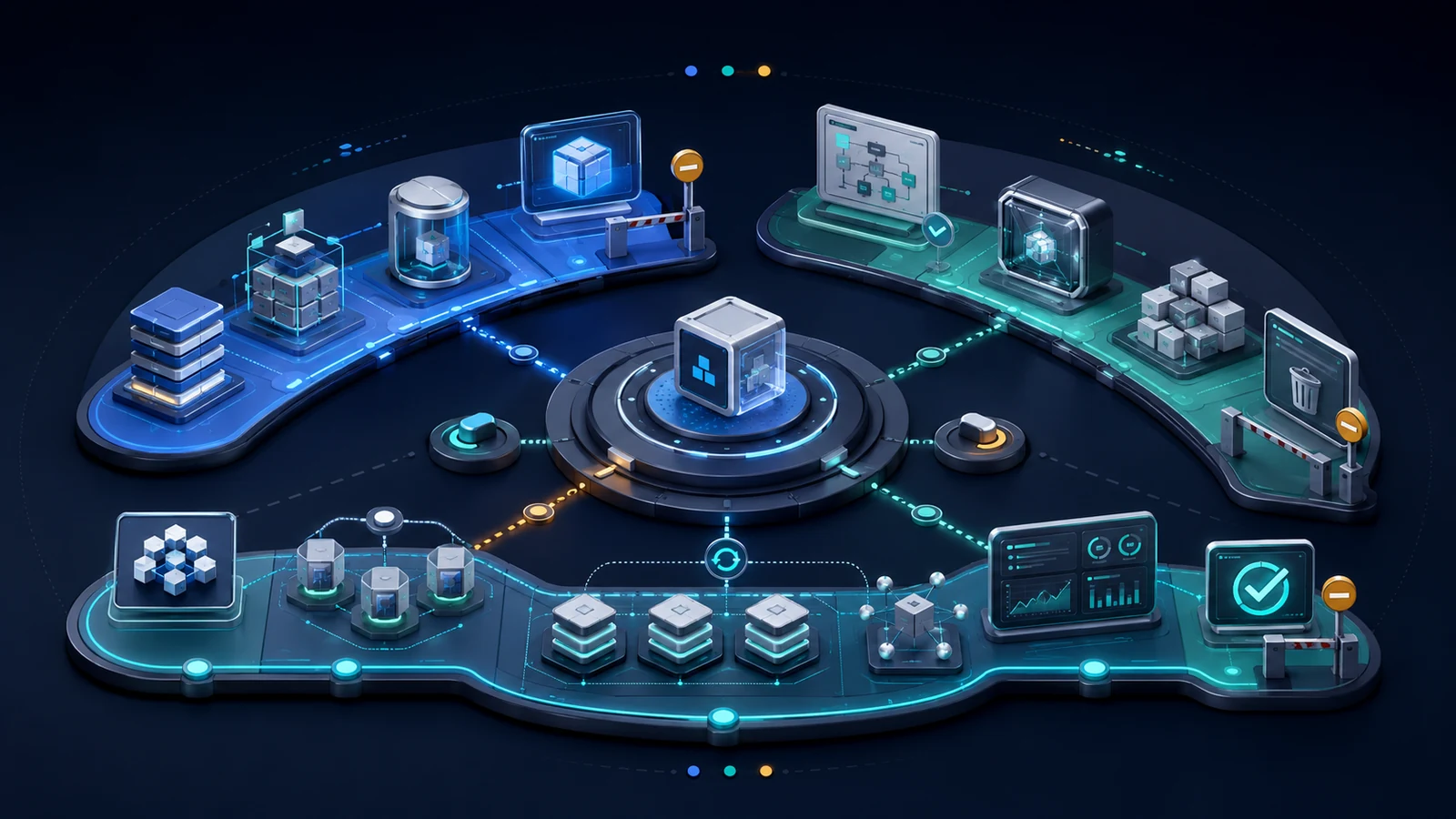
Evidence profile: E1 source-led research, so this is a documentation-based sequence rather than a tested learner path. Choose the next technology by the capability you need to produce, not by a three-logo checklist. Learn Docker first when you need a repeatable application image and local container workflow. Add Kubernetes only when you have a working containerized workload and a real orchestration question. Learn Terraform when you need repeatable, reviewable provisioning of infrastructure; that track can begin before Kubernetes if infrastructure is your immediate responsibility.
Advance only after you can show a small evidence artifact and explain its limits. A Dockerfile does not prove orchestration, a Kubernetes manifest does not provision every dependency, and Terraform configuration does not package the application.
Evidence and scope
- Evidence profile
- E1 – current official documentation review
- Information checked
- Audience
- Beginner to intermediate technical learners choosing a capability-led sequence
- Scope
- Docker for application packaging, Kubernetes for orchestration, and Terraform for infrastructure provisioning
- Direct evaluation
- Not performed
- Main limitation
- No image build, container run, cluster, cloud account, provider resource, plan, apply, rollout, or learner sequence was directly evaluated.
This guide turns official documentation into a planning method. It does not identify one universal order, promise a completion time, or establish that a course or lab fits a particular learner. See How we test for the evidence labels and testing boundaries used here.
What each technology owns
Docker owns the application-package question. Docker documents an image as a read-only template and a container as a runnable instance. A Dockerfile records image-build instructions, while Compose defines a multi-container application and its services, networks, and volumes. That makes Docker the natural first step when the missing capability is “package and run this application consistently,” not “operate a cluster.” Docker’s platform overview, Dockerfile guidance, and Compose documentation define those boundaries.
Kubernetes owns the orchestration question. Kubernetes manages containerized workloads through desired state. Pods carry containers; Deployments manage replicated application workloads and rollouts; Services provide a stable network abstraction for changing Pods; ConfigMaps and Secrets separate configuration concerns. Kubernetes documentation also says the platform does not build source code or prescribe a complete CI/CD, logging, or monitoring system. The Kubernetes overview, workload concepts, and Deployment documentation support this scope.
Terraform owns the infrastructure-provisioning question. Terraform configuration describes provider-managed resources, the plan step previews proposed changes, and state maps configuration to real objects. It can therefore precede Kubernetes for someone whose immediate job is to create networks, compute, managed services, or a cluster foundation. HashiCorp’s Terraform introduction, provider documentation, and plan reference define that workflow.
Audit your prerequisites before choosing an order
Start with one version-controlled application or one bounded infrastructure target. A technology name without a workload produces weak evidence because there is no result to inspect. Record the current state, the capability gap, and the environment you are authorized to change. For a broader starting point, see the cloud and DevOps learning-path guide.
- Application baseline: you can run the application, identify its process, ports, configuration, data, dependencies, and failure signals.
- Command-line and version-control baseline: you can read command output, compare file changes, and reverse a local change without exposing credentials.
- Docker readiness: you have an application that can be built and started, plus permission to install or use a container runtime.
- Kubernetes readiness: the image already runs, you understand basic networking and configuration, and you have an authorized learning cluster or sandbox.
- Terraform readiness: you understand the target provider’s resource model, have a bounded account or sandbox, and know who owns credentials, cost, cleanup, and state.
Separate concept readiness from environment readiness. You may understand a manifest but still lack a safe cluster, or understand HCL while lacking provider permissions and a state backend. In either case, use documentation and a local or disposable exercise until the operational boundary is approved. Do not convert course completion into permission to operate a real environment.
Stop the sequence audit when the workload, access boundary, or cleanup owner is unknown. Resolve that dependency before buying a larger course or adding another tool.
Choose a sequence by the capability you need
On a small screen, swipe or scroll the table horizontally to compare all columns.
| Starting situation | Sequence | Evidence before advancing | Stop or defer when |
|---|---|---|---|
| Application runs locally but packaging varies | Application basics -> Docker -> Kubernetes only if orchestration is required | Repeatable image build and local run; optional Compose definition | The image is not reproducible, configuration is unclear, or one host is sufficient |
| Cloud resources are created manually | Provider fundamentals -> Terraform | Reviewed configuration, interpretable plan, state/backend note, and cleanup record | You cannot explain the provider resource, permissions, cost, or state location |
| Team ships a version-controlled service | Application -> Docker -> CI/CD handoff -> Kubernetes | Tagged image, deployment and Service manifests, rollout and troubleshooting notes | The delivery process cannot produce a known image or there is no cluster-level need |
| Platform foundation is the immediate goal | Infrastructure fundamentals -> Terraform -> platform deployment; add Docker/Kubernetes as the workload requires | Small provider resource graph and controlled plan/apply/destroy lifecycle | The learner is copying modules without understanding resources or dependencies |
| A service already runs | Observe it first -> reliability practice -> add tooling only for a measured gap | Logs, health signal, failure note, and one improvement hypothesis | “Learn the stack” is the only reason to add another technology |
Takeaway: Docker and Terraform may be parallel foundations. Kubernetes normally follows a working image because it schedules and manages containerized workloads; Terraform may come earlier when provisioning is the actual task.
Run the sequence checkpoint
1. Define one capability, not three tools
Write an observable result: “build and run the same service from an image,” “declare and review a network change,” or “roll out a known image and inspect status.” Reject goals such as “learn DevOps” or “finish Docker, Kubernetes, and Terraform.”
2. Choose the smallest representative workload
Use one service or one small resource graph. Record inputs, expected behavior, data persistence, ports, dependencies, and cleanup. The workload should be small enough that a failure can be traced without adding another platform.
3. Build Docker evidence only when packaging is the gap
Create a Dockerfile, build the image, run a new container, and explain the image, runtime configuration, network, and persistent data. Use Compose only when multiple local services need one declared model. Docker warns that build arguments and environment variables are inappropriate for build secrets; use the documented secret or SSH mount mechanism instead. Docker’s build-secrets guidance supports that boundary.
Advance when: another authorized user or environment can reproduce the build and run from the files and notes. Defer Kubernetes when: the remaining problem is still the image, application startup, local configuration, or basic networking.
4. Build Terraform evidence when provisioning is the gap
Start with one provider and a few resources whose relationships you understand. Read the configuration, initialize it, inspect a plan, and explain create, update, replace, and destroy implications before any authorized apply. The documented workflow separates write, plan, and apply; providers connect Terraform to remote APIs. Terraform language guidance and the core workflow support this sequence.
Advance when: you can interpret the plan and describe state, backend, credentials, cost, and cleanup. Stop when: you cannot distinguish a configuration change from an out-of-band change or cannot safely remove the resources.
5. Add Kubernetes for a cluster-level question
Use a known image. Declare a Deployment, expose it with a Service when needed, separate non-confidential configuration with a ConfigMap, and inspect desired versus observed status. Kubernetes documents Deployments as declarative updates to Pods and ReplicaSets and Services as stable access to changing endpoints. Service documentation and ConfigMap documentation define those roles.
Advance when: you can explain the manifest set, image reference, selectors, rollout status, configuration, and one troubleshooting observation. Defer when: a single local runtime answers the workload need or cluster access is only an abstract course exercise.
6. Connect artifacts without hiding ownership
Keep application source, Dockerfile or Compose file, Kubernetes manifests, and Terraform configuration in distinct reviewable areas. Document which layer creates the image, which deploys the workload, and which provisions infrastructure. Do not make one tool appear to own another tool’s state or security model.
7. Observe the result before adding the next technology
Capture build output, container status, plan summary, rollout status, events, logs, or a health response appropriate to the step. The artifact should answer what changed and what remains unknown. A successful command alone is not evidence that the system is secure, reliable, accessible, or cost-effective.
8. Run a continue, revise, or stop decision
- Continue
- The artifact is reproducible, the next tool owns a named capability gap, and access and cleanup are controlled.
- Revise
- The goal remains valid, but the workload, environment, configuration, or evidence is too broad.
- Stop or defer
- The current capability is sufficient, the next layer adds no observed value, or authorization, cost, secrets, state, and cleanup are unresolved.
Defer a tool when it is not yet needed
- Use a local process and a written setup script before Docker when packaging is not the current constraint.
- Use Docker or Compose without Kubernetes when one machine and a small service set meet the learning goal.
- Use a provider console or documented manual exercise to understand one resource before encoding it in Terraform, within an authorized sandbox.
- Use an existing managed cluster or local learning cluster rather than provisioning a production-like platform.
- Study networking, Linux, Git, CI/CD, or observability first when that missing foundation prevents meaningful tool evidence.
Unknowns and limitations
- No Docker build, Compose application, Kubernetes cluster, provider account, Terraform plan, state backend, or cleanup operation was directly tested.
- No course inventory, lab quality, support, accessibility, reliability, device, regional access, or completion time was evaluated.
- The sequences are source-supported planning examples, not tested learner journeys or mandatory prerequisites.
- No price, certification, employment, salary, promotion, hiring, return-on-investment, or job-readiness claim is made.
- No weighted score, ranking, winner, affiliate relationship, or product recommendation is included.
- Provider APIs, Kubernetes versions, Docker behavior, and Terraform documentation can change; recheck the exact environment and sources after .
Create the first evidence artifact
Choose one lane and write a one-page record before adding another technology:
- Capability: one observable result and why it matters.
- Prerequisites: application, infrastructure, access, networking, Git, and command-line gaps.
- Authorized environment: owner, account or cluster, cost limit, secrets route, and cleanup rule.
- Artifact: Dockerfile and run notes; Kubernetes manifest set and rollout explanation; or Terraform configuration, plan interpretation, state/backend note, and cleanup record.
- Evidence: the output or observation that supports the result, plus what it does not prove.
- Checkpoint: continue, revise, or stop, and the exact capability the next technology would add.
On a small screen, swipe or scroll the table horizontally to compare all columns.
| Technology | Keep | Explain | Do not infer |
|---|---|---|---|
| Docker | Dockerfile, optional Compose file, build command, run command, and sanitized output | Base image, layers, runtime configuration, ports, networks, volumes, and rebuild trigger | Cluster readiness, production security, portability across every environment, or operational reliability |
| Kubernetes | Deployment, Service when needed, configuration objects, rollout status, and troubleshooting note | Desired state, selectors, image reference, replicas, configuration, service discovery, and observed status | A secure production cluster, successful public exposure, complete observability, or tested resilience |
| Terraform | Configuration, provider lock information, plan summary, state/backend note, and destroy or cleanup record | Resource graph, provider permissions, proposed actions, state ownership, cost boundary, and rollback limits | Apply success, zero drift, provider independence, safe secret storage, or a low-cost deployment |
The artifact is a checkpoint, not a portfolio or employment claim. Sanitize it before sharing and keep enough context to reproduce the reasoning without exposing credentials, account identifiers, private endpoints, or protected course material.
Add the next technology only when that final line names a gap the current artifact cannot close. Tool collection without a workload is a stop condition, not progress.
Methodology
This source-led workflow guide uses 18 official public documentation pages checked on . Eighteen approved claims define Docker packaging, Kubernetes orchestration, Terraform provisioning, declarative workflows, plans, state, configuration, networking, and secret-handling boundaries. Editorial synthesis converts those documented roles into conditional sequences, prerequisite checks, evidence artifacts, and stop rules.
This guide did not use paid or protected access, direct evaluation, participant research, an original study, weighted scoring, or affiliate research. The method does not evaluate a course, platform, learner outcome, or universal technology order.
Sources
- What is Docker? – Docker Docs. Checked September 11, 2026.
- Dockerfile overview – Docker Docs. Checked September 11, 2026.
- Docker Compose – Docker Docs. Checked September 11, 2026.
- Build secrets – Docker Docs. Checked September 11, 2026.
- Overview – Kubernetes Documentation. Checked September 11, 2026.
- Workloads – Kubernetes Documentation. Checked September 11, 2026.
- Deployments – Kubernetes Documentation. Checked September 11, 2026.
- Service – Kubernetes Documentation. Checked September 11, 2026.
- ConfigMaps – Kubernetes Documentation. Checked September 11, 2026.
- Secrets – Kubernetes Documentation. Checked September 11, 2026.
- Kubernetes Object Management – Kubernetes Documentation. Checked September 11, 2026.
- What is Terraform – HashiCorp Developer. Checked September 11, 2026.
- Overview – Configuration Language – HashiCorp Developer. Checked September 11, 2026.
- Providers – Configuration Language – HashiCorp Developer. Checked September 11, 2026.
- terraform plan command reference – HashiCorp Developer. Checked September 11, 2026.
- Terraform workflow for provisioning infrastructure – HashiCorp Developer. Checked September 11, 2026.
- State – HashiCorp Developer. Checked September 11, 2026.
- Manage sensitive data in your configuration – HashiCorp Developer. Checked September 11, 2026.